
A year ago, “we’re exploring AI” was a perfectly acceptable answer in a UAE boardroom. Nobody blinked. Today, that same sentence gets you a raised eyebrow, because half the room already shipped something. The other half is quietly panicking about why they haven’t.
That’s the honest state of AI development in the UAE heading into 2026. This isn’t a market dabbling anymore, Stanford’s own AI Index has flagged the UAE as one of the world’s leading hubs for adoption, and more than 80% of employees here are already using AI at work on a regular basis. When a government mandates AI literacy in schools starting at grade level and backs it with a $500 million R&D commitment, you know the “wait and see” phase is over.
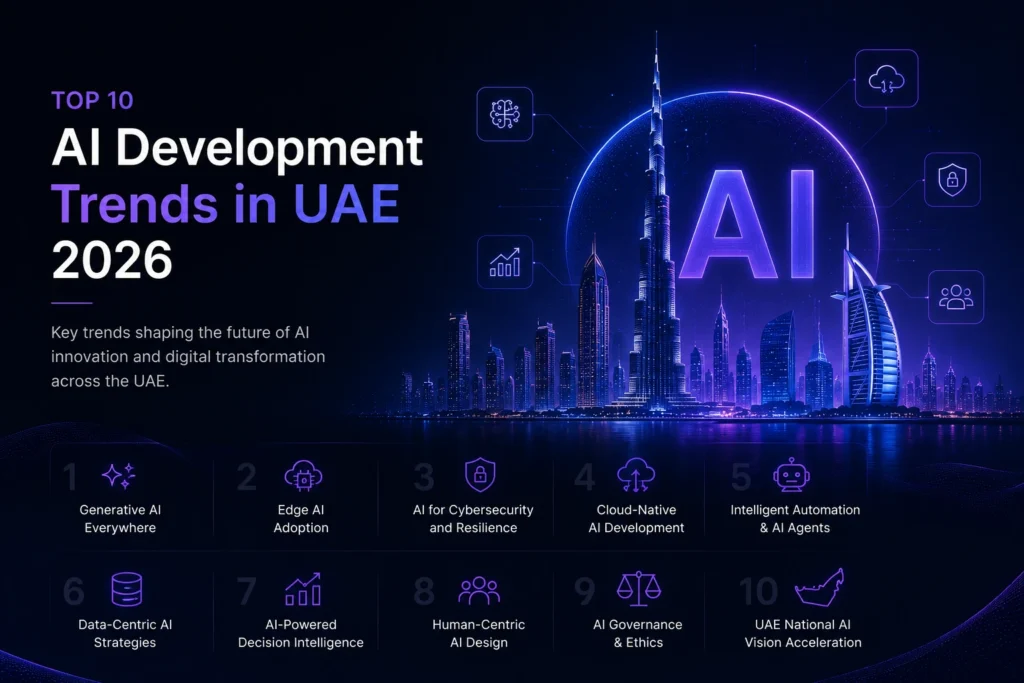
So what’s actually shaping AI development in the UAE this year not the buzzwords, the real shifts? Here are the ten trends worth paying attention to, and what they actually mean if you’re the one deciding where your budget goes next.
1. Agentic AI Is Replacing “Ask and Answer” Tools
For the last couple of years, AI meant a chatbot that answered a question and stopped. That’s changing fast. The trend everyone’s now chasing is agentic AI, systems that don’t just respond, they act. Book the appointment. Update the CRM. Chase the invoice. Escalate the ticket if nobody replies in two hours.
Microsoft has openly called this the shift from AI as a tool that answers questions to AI as a coworker that gets things done. In the UAE specifically, this is showing up fastest in real estate, healthcare scheduling, and customer service, industries where someone used to sit and manually push a process from step one to step five. Now an agent does that, and a human only steps in when judgment is genuinely needed.
2. Sovereign AI Is Becoming a National Priority
This one’s less talked about outside government and enterprise circles, but it’s massive. The UAE isn’t content being a customer of foreign AI models forever, it wants sovereign AI, meaning models, data, and infrastructure that live and operate within the country’s own control.
Abu Dhabi’s Technology Innovation Institute and its Falcon model family are the clearest example of this in motion, alongside a $500 million R&D push and a joint AI campus project with the US that’s expected to bring serious data centre capacity to the region. For enterprises, the practical takeaway is this: expect more pressure, and eventually more requirements, around where your AI systems process and store data.
3. AI Governance Stops Being Optional
If 2024 and 2025 were about proving AI works, 2026 is about proving it works safely, explainably, and fairly. Regulators across the Gulf, not just in the UAE are moving from “please be responsible” guidelines to enforceable frameworks. That means model explainability, bias checks, and human oversight aren’t nice-to-haves anymore, especially in finance, healthcare, and anything touching government data.
Deloitte’s Middle East AI Institute has been blunt about this shift: clients aren’t just asking whether a model performs well anymore, they’re asking whether it can be explained to auditors, regulators, and ethics committees. If your AI vendor can’t answer “how does this decision get made” in plain language, that’s a red flag worth taking seriously in 2026.
4. Bilingual, Arabic-First AI Is No Longer a Nice-to-Have
For years, “AI in Arabic” meant a translated version of an English-first tool, and it usually showed. Customers noticed the stiff phrasing and moved on. That’s shifting hard now. Enterprises are expecting AI systems, chatbots, voice assistants, document tools that were actually built with Arabic and English running side by side from day one, not bolted together after launch.
This matters more in the UAE than almost anywhere else, because a single customer conversation can flip between Arabic, English, Hindi, and Urdu without warning. AI development services teams that treat Arabic support as an afterthought are going to keep losing to the ones who built for it from the start.
5. Physical AI Starts Moving Off the Screen
Most people still picture AI as something that lives in a chat window. That’s changing as physical AI robotics, smart infrastructure, autonomous systems, starts scaling in the region. Dubai’s AI-driven smart traffic systems, which read live camera and sensor data to ease congestion in real time, are a working example already in production, not a concept slide.
Expect this to expand into logistics, warehousing, and facility management over the next 12 months, as AI moves from purely digital tasks into coordinating physical operations.
6. AI Gets Built Into Products Early, Not Bolted On Late
There was a period where “adding AI” meant tacking a recommendation widget onto an app right before launch, mostly for the pitch deck. That approach is dead. Development teams across the UAE are now baking AI into the earliest planning conversations recommendation logic, predictive personalization, and intelligent automation are part of the initial product spec, not a feature sprint tacked on at the end.
The practical effect: products that feel genuinely smart from day one, instead of ones with an AI feature awkwardly wedged into the settings menu.
7. Workflow Automation Becomes the Real ROI Story
Chatbots get the attention, but the money is quietly being made somewhere else, in workflow automation. Lead qualification, document processing, ticket triage, approvals, follow-ups: the unglamorous back-office tasks that eat hours every single day. Businesses that automate these first tend to see returns faster than the ones chasing flashy customer-facing AI features.
This is exactly where a lot of the real budget is shifting in 2026, not toward “an AI chatbot” as a standalone project, but toward connected automation that touches CRM systems, WhatsApp Business, ticketing tools, and internal databases all at once. Korvax AI, a Dubai-based AI automation agency, has built its whole model around this exact gap, replacing manual, repetitive processes with AI-powered workflows that plug directly into tools like Salesforce, HubSpot, Zoho, and WhatsApp Business, so businesses aren’t stitching five disconnected tools together themselves.
8. AI Talent and Education Get a National Push
The UAE mandated AI education across all school grade levels starting the 2025–26 academic year, covering everything from basic algorithms to ethics and project design. Combined with government-backed talent programs and partnerships with institutions like KAUST and Mohamed bin Zayed University of Artificial Intelligence, the country is deliberately building a homegrown AI workforce instead of only importing it.
For enterprises, this means the local hiring pool for AI-literate talent is only going to get deeper, but competition for genuinely experienced AI development teams is still tight in the short term, which is part of why external development partners remain in high demand.
9. Post-Launch Optimization Becomes Standard Practice
A pattern that kept repeating in 2025 UAE AI projects: businesses would launch an AI tool, celebrate, and then quietly watch its performance drift over the following months as data changed and use cases evolved. Nobody budgeted for the after-launch work.
That’s shifting now. Serious AI development companies are building “discover, design, develop, deploy, and optimize” into their delivery model from the start, treating post-launch tuning as part of the core service rather than a separate ask later. It’s a small mindset shift with a big impact on whether an AI system is still useful a year after it goes live.
10. AI-First Becomes the Default Selection Criteria, Not a Bonus
Maybe the biggest shift of all: businesses evaluating a development partner in 2026 no longer ask “do you also do AI?” as an afterthought. They ask about AI capability first, the way they used to ask about mobile-readiness a decade ago. Being AI-first, Arabic-first, and security-first at once is becoming the baseline expectation for any serious technology partner in the UAE, not a differentiator anymore.
This is pushing a lot of generic software agencies to either genuinely build AI expertise or get quietly filtered out of enterprise shortlists altogether.
What This Means If You’re Choosing Where to Invest
Put these ten trends together and the picture is pretty clear: 2026 isn’t about experimenting with AI anymore, it’s about who operationalizes it properly, with governance built in, Arabic support that doesn’t feel translated, and automation that actually connects to the tools a business already runs on.
That’s the exact space Korvax AI works in. As a Dubai-based AI automation agency, their focus sits across four areas that map almost directly onto the trends above: AI-powered assistants and RAG-based chatbots that hold real context across web, WhatsApp, and social channels in both Arabic and English; core workflow automation that replaces manual processes like lead qualification and document handling; custom AI development that integrates cleanly into existing platforms such as Shopify, Salesforce, and Zoho; and AI consulting to map out which use cases are actually worth building first. Their delivery process runs through discovery, design, development, and deployment with ongoing optimization, and most first AI agents for clients across real estate, healthcare, e-commerce, and finance in the UAE and GCC go live within four to six weeks.
If there’s one takeaway from watching this space move as fast as it has, it’s this: the businesses pulling ahead in the UAE aren’t necessarily the ones with the biggest AI budget. They’re the ones that picked the right first problem to solve, found a development partner who actually understands this market, and started before everyone else stopped debating whether to.