
Every vendor in the UAE is calling their product an “AI agent” right now.
Last year, they were calling it a chatbot. The year before, it was “conversational AI.” The technology has not always changed, the marketing has.
This creates a real problem for business owners trying to make smart investment decisions. You end up paying for complexity you do not need, or worse, buying a simple chatbot when your business actually needed something that can take action.
This guide cuts through the noise. By the end, you will know exactly which one your business needs, and why the difference matters more than most vendors want you to realise.
The Simple Version First
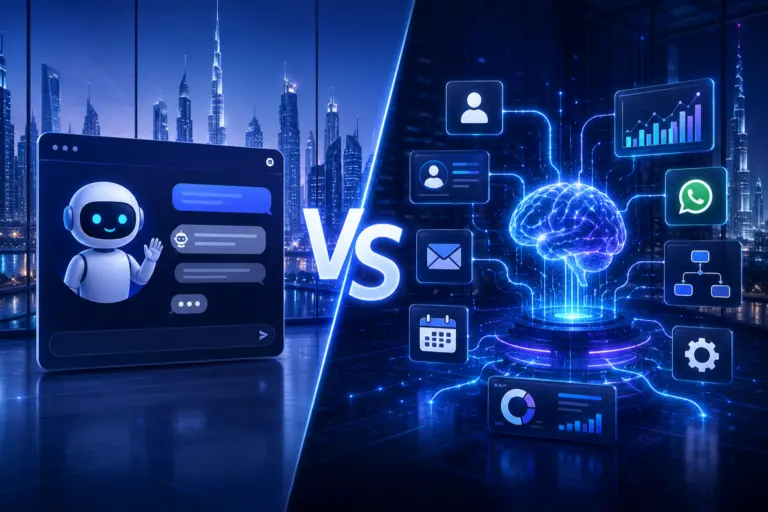
A chatbot answers questions. An AI agent takes action.
That is the real distinction. Everything else is detail.
A chatbot waits for you to ask something, responds with information, and stops there. It lives inside the conversation window.
An AI agent, what is now commonly called agentic AI can reason about a goal, decide what to do next, execute tasks across multiple systems, and continue working without a human instructing every step.
The metaphor that works best: a chatbot is a very smart librarian who finds information for you. An agentic AI is a researcher who reads the books, writes the report, emails it to your boss, and puts the follow-up meeting in the calendar.
Why This Distinction Matters More in 2026
For the past three years, “AI” in most UAE businesses meant putting a chatbot on a website or WhatsApp. That was genuinely useful, and for many use cases, still is.
But Gartner now projects that 40% of enterprise applications will include task-specific AI agents by the end of 2026. According to Cloudera, 96% of enterprises are already expanding their use of AI agents in operations, analytics, and IT.
The shift from conversation to execution is happening at speed. And in a market as competitive as the UAE and GCC, understanding which tool fits your problem is now a real business decision, not just a technical one.
What a Chatbot Does Well (And Where It Falls Apart)
Chatbots are genuinely excellent at specific, bounded tasks:
- Answering FAQs 24/7 without human oversight
- Capturing lead information from website visitors or WhatsApp
- Booking appointments based on availability
- Providing pricing, product information, or policy details
- Routing inquiries to the right human or department
For these use cases, a well-built NLP chatbot particularly one with RAG architecture that pulls from your own knowledge base is the most cost-effective solution available.
Where chatbots fall apart: anything that requires action after the conversation ends. Ask a chatbot to pull your CRM data, identify leads that have gone cold for 14 days, personalize a follow-up message for each one, send the messages, and update the CRM with the outcome. It cannot do that.
What Agentic AI Does That Chatbots Cannot
An AI agent works with tools. It connects to your CRM, your email, your project management platform, your databases, and it takes actions across all of them in response to a goal. You do not tell it step-by-step what to do. You tell it what you want to achieve, and it figures out how.
Real examples of what agentic AI can handle for a UAE business:
Sales Operations
Monitor all new inbound leads, score them against your criteria, assign them to the right sales rep based on their current workload, send a personalized introduction email, and add a follow-up task to your CRM, all automatically, within minutes of the lead arriving.
Healthcare Admin
Pull all appointment no-shows from the past 48 hours, check patient history to determine priority for rescheduling, send personalized rescheduling messages via WhatsApp, and update the clinic’s scheduling system.
E-commerce
Monitor for cart abandonments over AED 500, check customer purchase history, generate a personalized discount offer based on the customer’s category preferences, send it via WhatsApp, and log the outcome in the analytics dashboard.
Legal Intake
Screen all incoming client enquiries by legal matter type, collect the relevant information upfront, assess urgency, assign to the correct practice group, and send a case reference and next steps to the client, all without a paralegal touching the file until review is genuinely needed.
This is what our Agentic AI Development and AI Agents & Advanced Automation services are built for.
The Cost Difference Is Real
A well-built NLP chatbot for the UAE market costs AED 45,000 – AED 150,000. An agentic AI system with meaningful multi-system integration and autonomous workflow execution typically starts at AED 150,000 and can scale well above AED 400,000 for complex enterprise deployments.
The industry is blurring this line deliberately because “AI agent” commands higher pricing. Be critical when a vendor calls something an “agent” without being able to explain clearly what actions it takes, across which systems, and how it handles failures.
The Decision Framework: Which One Do You Actually Need?
Ask yourself these five questions:
- Does the task end when the conversation ends? If yes, chatbot. If the task requires follow-up actions in other systems, you need an agent.
- Does the task involve more than one software system? If your workflow only touches a single platform, a chatbot is sufficient. If it needs to read from your CRM, write to your email, and update your calendar, you need an agent.
- Is a human currently doing copy-paste work between systems? If someone on your team spends time moving data from one tool to another, that is a perfect agentic AI use case.
- Does the decision require context from multiple sources? A chatbot can answer using your knowledge base. An agent can pull context from your CRM history, email thread, product database, and live inventory.
- Does failure matter a lot? Agentic AI systems need robust error handling. For high-stakes workflows, build in human checkpoints.
A Hybrid Approach Often Makes Sense
Many UAE businesses that are genuinely further ahead on AI use both. A chatbot handles all inbound customer conversations. When a conversation reaches a trigger point, an AI agent takes over, pulling context, triggering workflows, and acting across systems.
Our AI Automation & Workflows team specifically designs these layered systems for GCC businesses, where the chatbot handles the front door and the agentic layer handles the back office.
The Bottom Line
If you need answers: chatbot. If you need actions: agent.
Most UAE businesses right now need a high-quality chatbot, well-integrated with their core systems, that actually handles Arabic dialects and WhatsApp properly. That is the biggest gap in the market, not a lack of AI agents, but a lack of chatbots that are actually built correctly.
If you are not sure which applies to your situation, talk to the Korvax AI an AI Automation Agency, and we will give you an honest assessment of what your business actually needs, not what sounds most impressive.