

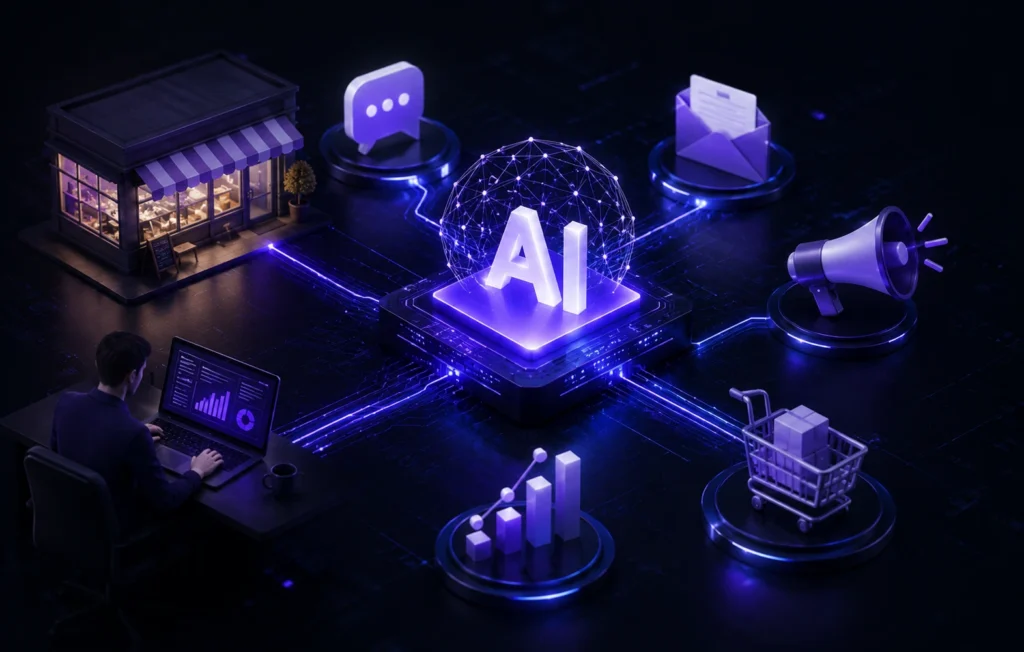
There’s a version of the AI conversation that’s all about the future, self-driving everything, robots, jobs that may or may not exist in ten years. It’s an interesting conversation, and it has almost nothing to do with what’s happening inside small businesses right now. Because while the think-pieces argue about 2035, the bakery down the road is already using AI to answer its phone, the e-commerce store is using it to recover abandoned carts overnight, and the two-person consultancy is drafting a week’s worth of content in an afternoon.
That’s the part that gets lost. Artificial intelligence stopped being a someday-technology for small businesses and became a right-now tool, quietly doing real work in the background of companies that don’t have a tech department or a big budget. In 2026, over two-thirds of small businesses report using AI regularly, not experimentally, but as part of how they actually operate. This isn’t about hype or predictions. Here are five concrete ways small businesses are putting AI to work today, and what it’s actually getting them.
1. Answering Customers Instantly, at Every Hour
This is the single most common starting point, and usually the fastest to pay off. Every small business knows the feeling of a customer message arriving at 9pm, or a call coming in while everyone’s busy with someone else. In the past, that meant a voicemail, a slow reply the next morning, and often a lost sale.
Now small businesses deploy AI to handle that first line of contact automatically. AI receptionists answer calls around the clock, respond naturally to common questions, and even book appointments. AI chat handles the flood of “what’s your price,” “are you open,” “do you deliver” questions the moment they land, in the customer’s own language. And it works: 72% of small businesses using AI-driven customer support report faster resolution times, and roughly half of the routine queries can be resolved instantly without a human ever touching them.
The key thing small businesses get right here is that AI handles the repetitive volume, not the delicate conversations. A conversational AI system deals with the predictable questions and escalates the genuinely complex or sensitive ones to a person, with the full conversation already summarized so the human picks up mid-context instead of starting cold.
2. Creating Marketing Content Without a Marketing Team
For most small businesses, marketing is the thing that gets dropped first when everyone’s busy, which is exactly why it’s the second-biggest AI use case. Writing a week of social posts, drafting product descriptions, putting together an email campaign, these are time-consuming tasks that require consistency more than genius, and that’s precisely where AI is strongest.
Small business owners now use AI to draft blog articles, generate product descriptions, write email sequences, and produce social media captions in a fraction of the time it used to take. Around 47% of small business marketers rely on AI for ad targeting, and content creation consistently ranks as one of the highest-ROI, lowest-barrier ways to start with AI at all. The output isn’t publish-and-forget, the smart approach is AI drafts, a human edits and adds the brand voice, but that split still turns a full day of writing into an hour.
The result is a small business that shows up consistently, posts regularly, and keeps its email list warm, without hiring a marketing team it can’t afford.
3. Qualifying and Following Up on Leads Automatically
Here’s a quiet truth about most small businesses: the problem usually isn’t getting leads, it’s what happens to them afterward. A lead comes in, nobody gets to it for a few hours, and by the time someone follows up, the customer has already booked with whoever replied first. That gap is where revenue leaks out, and AI closes it.
Small businesses now use AI to qualify every inbound lead the moment it arrives, sorting the ready-to-buy from the just-browsing based on the actual conversation, then following up instantly instead of whenever someone remembers. For service businesses, dental clinics, law firms, plumbers, real estate agents, this single improvement can lift conversions without adding a single employee. This is where AI agents and advanced automation shift from a convenience into a direct revenue tool, working the pipeline around the clock so no lead goes cold overnight.
4. Taking Over the Repetitive Back-Office Work
The least glamorous use of AI is often the one that gives a small team the most hours back. Every small business is quietly buried under admin, categorizing invoices, chasing paperwork, updating records, reconciling data between systems that don’t talk to each other. It’s the work nobody enjoys and everybody has to do, and it eats time that should go toward customers.
AI now handles a lot of it. Bookkeeping tools automatically categorize transactions and flag anomalies. Data and document automation reads invoices and forms, extracts what matters, and routes it correctly without someone keying it in by hand. And the bigger win comes from connecting the tools a business already uses, so information flows from the store to the CRM to the accounting system automatically. Intelligent AI automation and workflows stitch those disconnected steps into one process that runs itself, which is how small businesses report saving 10 to 20 hours a week on operational busywork.
5. Personalizing the Customer Experience Like a Big Brand
For years, personalization was the advantage big companies had that small ones simply couldn’t match. Amazon and Netflix knew what you wanted before you did, while the small shop treated every customer identically because it had no way not to. AI erased that gap.
Small businesses now use AI to analyze customer behavior and preferences in real time, then tailor what each customer sees, product recommendations based on what someone actually browsed, email offers timed to their behavior, follow-ups that reference their specific history rather than a generic blast. The customer feels understood, and the small business delivers that one-to-one experience without a data science team behind it. It’s one of the clearest examples of AI letting a small business punch several weight classes above its size, and it’s a big part of why smaller, sharper companies keep out-competing larger, slower ones in fast-moving markets.
The Thread Running Through All Five
Notice what these five uses have in common. None of them is about replacing the people in a small business. Every one is about removing the repetitive, time-draining work that buries a small team, so the two, five, or ten people who actually run the place can spend their hours on the things that need a human, closing deals, solving real problems, building relationships.
That’s the pattern in every successful small business AI deployment: AI takes the predictable load, humans keep the judgment. The businesses getting it wrong are usually the ones trying to automate everything at once, or automating a broken process instead of fixing it first. The ones getting it right pick the single biggest time-drain, the thing consuming the most hours for the least judgment, and automate that first. Then they expand once it’s clearly working.
Where Korvax AI Fits In
The gap between reading about these AI use cases and actually having them running in your business is where most small businesses get stuck. The tools exist, but wiring them into your specific systems, in the languages your customers use, without breaking something, is where a specialized partner earns their place.
Korvax AI is a Dubai-based AI automation agency built specifically for the UAE and GCC market, with bilingual Arabic-English support and awareness of local data residency expectations. Rather than handing you a pile of tools, the team builds right-sized AI systems around your actual business, working across four connected areas:
- AI-Powered Assistants: Chatbots, RAG-based AI agents, and conversational AI that answer customers instantly across web, WhatsApp, and social channels.
- Core AI Automation & Workflows: Automating lead qualification, follow-up, and back-office paperwork with intelligent, connected workflows.
- Custom AI Development & Integration: Systems that plug cleanly into the platforms you already run, from Shopify and WhatsApp Business to your CRM.
- AI Consulting & Strategy: Helping you find the single highest-ROI place to start, so your first AI project actually pays off.
Korvax works with small businesses and enterprises alike, building right-sized solutions across real estate, healthcare, e-commerce, and finance, with most first systems live within four to six weeks and results documented in their case studies.
The Bottom Line
Artificial intelligence isn’t waiting for small businesses somewhere in the future, it’s already answering their phones, writing their content, qualifying their leads, clearing their paperwork, and personalizing their customer experience today. The businesses using it aren’t tech companies or well-funded startups. They’re ordinary small businesses that picked one painful, repetitive process and pointed AI at it.
That’s the whole trick, really. Not automating everything, not chasing every shiny tool, just finding the one place AI would take the most work off your team’s plate and starting there. Get that right, and a small business starts operating like one several times its size.
If you want a straight answer on which of these five would give your business the biggest win first, talk to Korvax AI and start with the one that actually moves the needle.
