

Picture a marketing manager at a mid-sized Dubai company on a Friday evening. The paid campaigns are running hard, the ads are pulling clicks, and the inbox is filling up with inquiries from across the week. By Monday, a good chunk of those leads have gone cold. Some never got a reply. Others got one, but it arrived a day late, after the prospect had already messaged a competitor on WhatsApp and gotten a quick answer. The ads did their job. What failed was everything that happens after the click.
That’s the quiet problem sitting underneath a lot of UAE marketing right now. Reach isn’t the bottleneck anymore. This is one of the most digitally saturated markets in the world, with internet penetration close to universal and digital ad spend forecast to pass US$2.6 billion this year. Everyone can get in front of an audience. The businesses pulling ahead are the ones turning attention into conversations and conversations into booked meetings, and AI is changing how that happens at every stage.
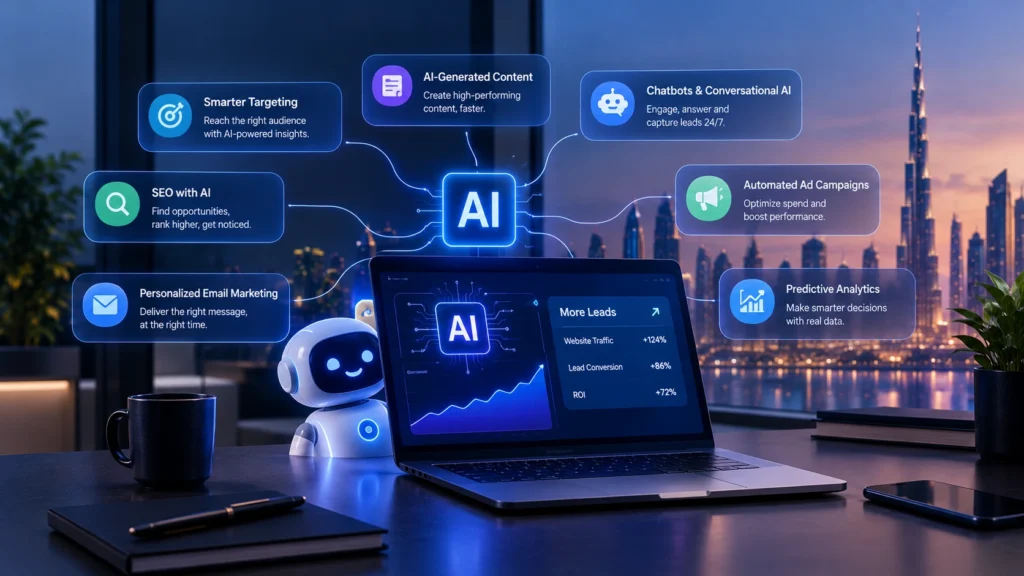
This article walks through seven concrete ways AI is being used in UAE digital marketing today to generate leads, what each one actually does, and where the real limits are. Some of these are straightforward wins. Others need more care than the hype suggests.
Why 2026 Feels Different for UAE Marketers
A few shifts have made this year a turning point rather than just another year of new tools.
The first is simple: audiences are everywhere, so the advantage has moved from reach to response. A prospect in Dubai can compare five providers in the time it takes to finish a coffee, and most of them expect an answer quickly, in Arabic or English, on the channel they already use every day. WhatsApp in particular has become a default business channel here, not an experiment.
The second is how people search. Google’s AI Overviews and answer engines like ChatGPT and Perplexity now sit between many searches and the websites behind them. Some benchmark reports put the click-through hit on informational queries at anywhere from 20 to 40 percent when an AI summary appears, which means the question for brands is shifting from “how do we rank” to “how do we get cited inside the answer.”
The third is that AI has moved from pilot to standard practice. Surveys show most marketing teams now use it in some form, but far fewer have connected those tools to how leads actually move through the business. That gap is where most of the opportunity sits.
1. Capturing and Qualifying Leads on WhatsApp Around the Clock
If there’s one use case that delivers the fastest return for UAE businesses, it’s this one. Most leads from paid ads and social posts don’t arrive through a form. They arrive as a message, usually on WhatsApp, usually outside office hours.
An AI assistant trained on your services, pricing guidelines, availability, and FAQs can respond the moment a message lands. It can ask the questions that matter, what the prospect needs, their timeline, their budget range, and whether they’re the decision maker, then route the qualified ones to your sales team with a clean summary. The unqualified or just-browsing conversations get handled politely without eating anyone’s afternoon.
The reason this works is speed and consistency. A human team can’t answer at 11pm on a Saturday, and a rushed reply at 8am Monday often misses the moment. An assistant does both jobs without losing its tone or forgetting a question.
The limit to watch is tone. A bot that sounds robotic, or pushes a prospect too hard, loses trust fast. The best setups make it obvious the conversation is being handled by an assistant, keep it useful rather than salesy, and hand off to a person the moment a conversation gets emotional, complicated, or high-value. AI-powered assistants built this way tend to outperform generic chat widgets because they’re grounded in your actual business information rather than guessing.
2. Scoring Leads by Intent, Not Just Form Fills
Not every lead is equal, and most marketing teams still treat them as if they were. A name and email from a gated download might be far less valuable than a short WhatsApp message asking about a specific unit size and a move-in date.
AI-driven lead scoring looks at the signals that actually predict buying: which pages someone visited, how often they came back, what they asked, how quickly they responded, and how their profile matches your best past customers. The output is a ranked list that tells your sales team who to call first.
This matters most in high-consideration categories like real estate, healthcare, education, and B2B services, where a sales rep’s time is expensive and the difference between a warm lead and a cold one can be the difference between a closed deal and a wasted week. Predictive scoring doesn’t replace your judgment about who’s worth pursuing, but it stops good leads from sitting untouched at the bottom of a spreadsheet.
The honest caveat is that scoring is only as good as the data behind it. If your CRM is messy, duplicated, or missing the outcomes of past deals, the model will confidently rank the wrong people. Cleaning that up first is usually the unglamorous step that makes everything else work.
3. Building Content That AI Search Engines Can Actually Cite
This is the use case most marketers are still catching up on. Traditional SEO was about getting a page to rank. Answer engine optimization is about getting your content quoted, summarized, or recommended when someone asks an AI tool a question in your category.
That changes what good content looks like. Pages built around clear, direct answers to specific questions, written with real expertise and supported by specific facts, tend to get pulled into AI summaries more often than vague brand copy. Structured data, clear headings, and content that answers “what is,” “how much,” “how long,” and “which is better” give answer engines something precise to work with.
AI helps here in two ways. It can analyze which questions your audience is actually asking across search, social, and sales conversations, so your content targets real demand. And it can help draft and refresh content at a pace a small team couldn’t manage alone. The part that still needs a human is accuracy and voice. An AI-written page full of generic claims is exactly the kind of content answer engines skip. The pages that earn citations are the ones with real specifics that only your business could publish.
4. Making Paid Ads Smarter Without Burning Budget
Paid media in the UAE is competitive, and cost per click varies a lot by category. AI-driven ad platforms now handle much of the bidding, audience matching, and placement optimization automatically. Used well, that can stop money leaking into audiences who were never going to convert.
The more interesting shift is in creative. AI can help generate multiple ad variations, test headlines and visuals against each other, and flag which messages are pulling clicks from the audience you actually want, not just the audience that clicks everything. For bilingual campaigns, it can adapt the same offer for Arabic and English audiences more thoughtfully than a simple translation.
Be careful, though. Automated bidding optimizes for whatever you tell it to. If you ask it to chase cheap clicks, it will find them. The marketer still has to define the right conversion event and check whether the leads are actually good.
5. Following Up With Leads Without Losing the Personal Touch
Most leads don’t convert on the first contact. They need two, three, or six touches before they’re ready, and that’s where marketing teams quietly drop the ball. Follow-ups get forgotten, sent too late, or sent as a generic blast that nobody reads.
AI-powered nurture sequences change that. Based on what a prospect actually did, whether they opened the last email, clicked a pricing page, or went quiet after asking about financing, the system can send the next relevant message at the right time, through the right channel. A prospect who asked about villa availability gets different follow-up than someone who downloaded a general guide.
The best nurture flows still sound like a person wrote them. That means referencing what the prospect actually said, keeping messages short, and knowing when to stop. Over-automated follow-up that keeps pinging someone after they’ve clearly moved on does more damage than silence.
6. Creating Bilingual Content at Scale Without Losing Your Voice
The UAE is a bilingual market, and the way your brand sounds in Arabic matters as much as the English. Many businesses have ended up with thin Arabic content, or Arabic pages that were clearly translated word for word and never felt natural.
AI can draft content in both languages and adapt it for different channels from one core message. It’s especially useful for the repetitive but important pieces: product descriptions, service pages, email templates, and FAQs that need to stay consistent across languages.
The catch is that Arabic copy needs a native speaker reviewing it. Machine-generated Arabic can sound stiff or get the register wrong, and that’s more visible than most people expect. The workable model is AI draft, human review, and clear brand guidelines.
7. Reading Your Marketing Data Honestly
The last use case is the one that makes the others accountable. Marketing teams are drowning in dashboards, but many still can’t answer a basic question: which channel produced the leads that actually closed?
AI-assisted analytics can connect ad spend, website behavior, WhatsApp conversations, and CRM outcomes into one view, then surface patterns a person would take days to find. It can flag when a campaign’s cost per qualified lead starts climbing, when a particular page is losing visitors to AI summaries, or when a segment of leads responds much better to a specific offer.
This only works if the underlying tracking is set up properly. If conversions aren’t tracked, if WhatsApp leads aren’t logged in the CRM, or if the sales team doesn’t record outcomes, the analytics will look impressive and tell you nothing useful. Getting the measurement right is the foundation, and it’s usually the first thing to fix before any fancy reporting is worth building.
Where This Goes Wrong
Most teams that struggle with AI don’t fail because the tools are weak. They buy several point solutions that don’t talk to each other, automate before defining what a good lead looks like, publish AI content without human checks, and measure activity like messages sent rather than pipeline and revenue. The fix is usually less about adding AI and more about connecting what already exists, working backward from a clear definition of a qualified lead.
Where Korvax AI Fits In
The gap between knowing these use cases exist and having them working together in one system is where most UAE businesses stall. Each one is manageable alone. The value comes from the connections between them.
Korvax AI is an AI automation agency based in Dubai, built around the UAE market, with bilingual Arabic-English capability and an understanding of how WhatsApp, local search behavior, and regional compliance expectations shape marketing in the Emirates. The work typically starts with AI consulting and strategy to decide which two or three use cases will move leads fastest for your business, then moves into building the systems that connect them.
Where the lead flow runs through messaging, that often means an AI assistant handling WhatsApp and web conversations, grounded in your real service information. Where scoring and follow-up matter, it means AI agents and advanced automation that route the right leads to the right people at the right moment. The point is to start with the bottleneck that’s costing you the most, prove it works, and expand from there.
The Bottom Line
AI is changing UAE digital marketing in a practical way. Reaching people has become easy. Responding to them quickly, qualifying them honestly, following up with relevance, and getting cited in the answers they now read first is where leads are won or lost.
The seven use cases here are not a checklist to complete in one quarter. Pick the one where your leads are leaking most, usually the gap between the first message and the first real conversation, and fix that first. Then measure, tighten, and move on to the next. Teams that do this steadily tend to end up with far more qualified conversations from the same ad budget, which is the real goal.
If you want a clear view of which of these would actually move leads for your business, talk to Korvax AI and start with the bottleneck that matters most.
