
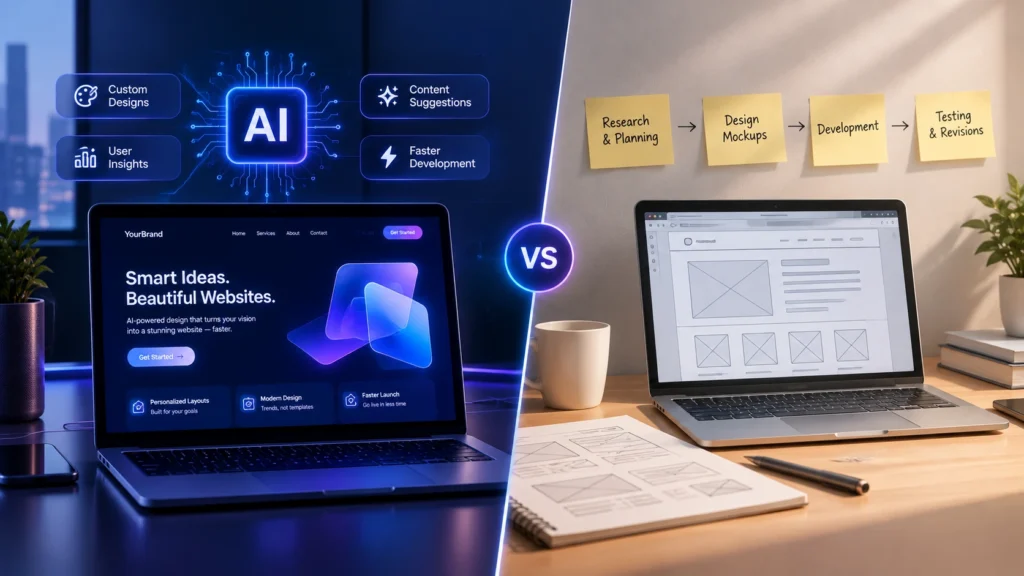
Quick answer: AI web design uses artificial intelligence to speed up layout, copy, imagery and personalization, and to adapt the site to each visitor. Traditional web design relies entirely on manual design and fixed pages. For most Dubai businesses, the best option is a hybrid: human designers set the brand and strategy, and AI handles speed, testing and personalization. Pure AI-generated sites are fast but often generic, while purely manual sites can be slow to improve.
Ask ten designers whether AI will replace them and you’ll get ten different answers. Ask ten business owners what they want from a website and you’ll get one: more enquiries.
That’s the lens we’ll use here. Forget the hype for a moment. What matters is which approach gets a Dubai business a faster, better-converting website, and when each one makes sense.
Here’s an honest comparison.
What is the difference between AI web design and traditional web design?
Traditional web design is a manual process. A designer researches your brand, sketches wireframes, builds layouts in a design tool, writes or collects content, and hands it to developers. Every element is a human decision. The result is a fixed site that changes only when someone updates it.
AI web design brings AI into the process and into the finished site. During the build, it can generate layout options, draft copy, produce imagery and suggest improvements quickly. After launch, it can personalize content, test variations automatically and adapt to what different visitors do.
So the real difference isn’t “robot vs human.” It’s a static site versus one that learns.
How do they compare side by side?
| Factor | Traditional web design | AI web design |
|---|---|---|
| Speed to first draft | Weeks | Days |
| Creative originality | High, when the designer is strong | Varies; can feel generic without human direction |
| Personalization | Limited and manual | Dynamic, per visitor |
| Testing and optimization | Occasional, manual A/B tests | Continuous and automated |
| Cost to launch | Moderate to high | Often lower for the build, with extra for AI features |
| Scalability | Needs manual updates | Adapts with data |
| Brand consistency | Strong, tightly controlled | Strong only with clear guardrails |
| Best for | Brand-led, one-off showcase sites | Lead generation, e-commerce, high-traffic sites |
What does AI do better?
Speed
AI shortens the loop between idea and design. Where a first round of layouts once took weeks, you can now review options within days. For businesses that need to launch before a campaign, season or event, that matters.
Personalization
This is the big one. McKinsey’s research shows that 71% of consumers expect personalized interactions and 76% get frustrated when they don’t get them. A traditional site shows the same page to everyone. An AI-driven site can adjust headlines, offers, product suggestions and calls to action based on who’s visiting and what they’ve done. A returning buyer, a first-time visitor and an Arabic-speaking visitor from Riyadh can each see something relevant.
Continuous testing
Traditional A/B tests take weeks to plan and read. AI-driven testing runs constantly, learning which headline, image or button actually converts and shifting traffic toward winners.
Accessibility and responsiveness
AI tools can flag contrast problems, missing alt text and layout issues across devices, making it easier to build sites that work for everyone.
What do traditional designers still do better?
Let’s be fair. There are things AI can’t do well on its own.
- Brand soul. A distinctive visual identity, tone and story come from people who understand your market and customers.
- Strategic thinking. Deciding what the site should say, who it should speak to and how it fits your sales process takes judgement.
- Cultural nuance. In the UAE, getting imagery, tone and Arabic layouts right takes cultural awareness. Generic AI output often misses it.
- Originality. Left alone, AI tends toward the average. If your competitors all use similar tools, you’ll all start looking alike.
That’s why the strongest results come from pairing the two.
Does web design actually affect conversions?
Yes, and often more than people realize. Two numbers worth knowing:
- Google’s mobile research found that 53% of mobile visits are abandoned if a page takes longer than three seconds to load.
- The same research found that as page load time goes from one second to seven seconds, the probability of a mobile visitor bouncing rises by 113%.
Design isn’t just how a site looks. It’s how fast it loads, how clearly it guides people and how easy it is to act. A beautiful site that loads slowly loses to a plain one that loads instantly.
This matters in the UAE especially. The 2025 Global Digital Shopping Index found that the UAE leads the world in mobile-driven online shopping, with 37% of purchases made on mobile. Your design is being judged on a phone, probably on the move.
Which should a Dubai business choose?
Here’s a simple way to decide.
Choose a mostly traditional approach if:
- Your site is mainly a brand showcase, such as a luxury brand, an architecture firm or a portfolio
- You get low traffic and don’t need ongoing optimization
- Design originality is your main differentiator
Choose an AI-driven approach if:
- Your site exists to generate leads or sales
- You have meaningful traffic and want to improve conversion continuously
- You serve multiple audiences or languages
- You want to capture and qualify enquiries after hours
Choose a hybrid approach if:
- You want a strong brand and measurable results (this is most businesses)
For most real estate firms, clinics, e-commerce brands, consultancies and service companies in Dubai, hybrid wins. A skilled team sets the strategy and brand. AI accelerates production, personalises the experience and keeps optimizing after launch.
What does AI web design include in practice?
A good AI-enhanced build typically covers:
- Strategy and brand direction, led by humans
- Conversion-focused page structure, built around your offer and funnel
- AI-assisted layout and content drafts, refined by designers and editors
- Bilingual design with proper Arabic right-to-left layouts
- Personalization rules, such as tailored offers by visitor type or location
- An AI assistant for answering questions and capturing leads
- Automated testing to improve headlines, forms and calls to action
- Performance optimization so the site stays fast
If you want the build costs behind these features, our AI website development cost guide for Dubai lays out the numbers.
What mistakes should you avoid?
- Publishing raw AI output. Unedited AI copy and imagery are often bland, sometimes wrong, and easy for visitors to spot. Always have a human review.
- Ignoring brand guardrails. Without clear rules, AI-generated variations can drift away from your identity.
- Over-personalizing. Personalization should feel helpful, not creepy. Use data you have permission to use.
- Forgetting speed. Stuffing a site with AI widgets can slow it down. Test performance after every feature.
- Skipping Arabic. A machine-translated Arabic page can damage trust. Have native speakers review it.
- Treating launch as the finish line. The advantage of AI design is what happens after launch. Plan to review the data monthly.
How do you find the right agency?
Look for a team that treats design and AI as one discipline, not two separate services. Ask to see conversion results, not just pretty screenshots. Ask how they handle Arabic, how they keep pages fast and how they protect brand consistency.
At Korvax AI, we’re an AI automation agency in Dubai, and our AI web design service pairs conversion-focused design with AI-driven personalization, assistants and automation. The aim is simple: turn visitors into leads, in Arabic and English, around the clock.
Frequently asked questions
Is AI web design better than traditional web design?
Neither is better in every case. AI web design is stronger for speed, personalization and continuous optimization. Traditional design is stronger for brand originality and strategic thinking. For most Dubai businesses, a hybrid approach delivers the best results.
Will AI replace web designers?
Not in any way that matters for your business. AI speeds up production and testing, but strategy, brand identity and cultural judgement still need skilled people. The best results come from designers who use AI as a tool.
Is AI web design cheaper?
The design phase can be faster and sometimes cheaper, but adding AI features like assistants, personalization and automation adds cost. Overall, expect a different spending pattern rather than a dramatically lower bill, with more value after launch.
Can AI design websites in Arabic?
AI can help produce Arabic layouts and content, but quality varies. Right-to-left design, dialect and cultural tone should always be reviewed by native speakers for any UAE or GCC audience.
How long does an AI web design project take?
Most business sites take roughly three to eight weeks, depending on size, integrations and design depth. AI helps shorten the early design stages, but testing and refinement still take time.
Final thoughts
The smartest question isn’t “AI or traditional?” It’s “what do I need my website to do?” If the answer is win more customers, a hybrid approach that blends human creativity with AI intelligence gives you the best shot.
Ready to see what that looks like for your business? Book a free strategy call with Korvax AI and we’ll walk you through the options.
