

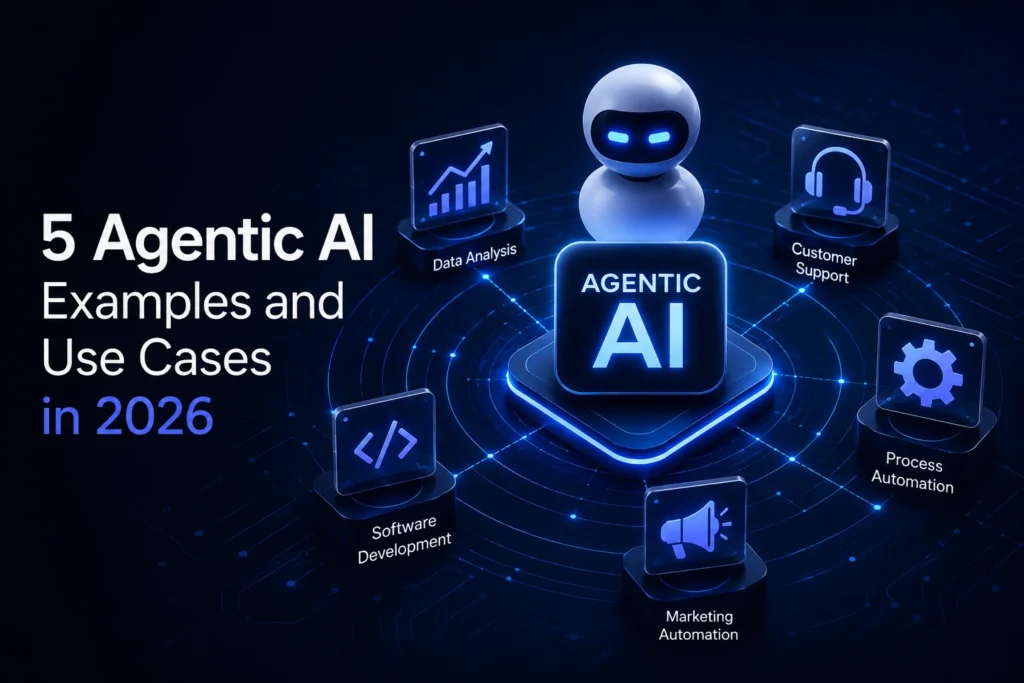
Quick answer: Agentic AI refers to AI systems that can plan, make decisions, and complete multi-step tasks on their own, with little to no human input at each step. Unlike a chatbot that answers one question at a time, an AI agent can figure out the steps needed to reach a goal, use tools or software to get there, and adjust its approach along the way. In 2026, businesses are using it for everything from resolving customer complaints to qualifying leads to catching cybersecurity threats before they spread.
If “AI agent” feels like a term you’ve suddenly started hearing everywhere, that’s not a coincidence. It’s the fastest-moving shift in enterprise software right now. Below, we’ll break down what actually separates agentic AI from regular automation, look at five real use cases businesses are running today, and cover how to tell if it’s worth exploring for your own operations.
What Makes Agentic AI Different?
Traditional automation follows fixed rules: if X happens, do Y. A basic chatbot answers a question, then waits for the next one. It doesn’t remember context, doesn’t make judgment calls, and can’t handle anything outside its script.
Agentic AI works differently. Instead of following a rigid script, it’s given a goal and figures out how to get there pulling data, using tools, checking its own work, and adapting when something doesn’t go as planned. Think of the difference between a vending machine (press a button, get a fixed result) and an assistant (tell them what you need, and they figure out the steps).
That distinction matters because it’s what allows agentic AI to handle real, messy business problems, not just answer FAQs, but actually resolve a customer’s issue, qualify a lead based on the conversation, or flag a security threat and act on it.
Why Agentic AI Is Everywhere in 2026
This isn’t a slow-burn trend, it’s one of the fastest technology shifts enterprise software has seen. A few numbers put that in perspective:
- 88% of enterprises already report regular use of AI, and 79% say AI agents are already being adopted somewhere within their organization.
- Gartner expects 40% of enterprise applications to embed task-specific AI agents by the end of 2026, up from less than 5% in 2025, one of the fastest technology integration shifts on record.
- Around 15% of business decisions are now expected to be made automatically by AI agents, meaning agents aren’t just supporting decisions anymore, they’re increasingly making them.
- Customer service and virtual assistants make up roughly 32% of the agentic AI market, the single largest use case driven by demand for instant, personalized, high-volume support.
- Salesforce’s Agentforce alone is generating around $800 million in annual recurring revenue, up 169% year over year, a strong signal of how fast businesses are putting real budget behind AI agents, not just testing them.
- Adoption isn’t limited to giant enterprises either. Customer service, supply chain logistics, and IT operations are seeing the widest adoption because they have well-defined, repeatable processes that suit AI agents well.
Worth noting: not every rollout succeeds. Only about 23% of organizations are scaling their AI agents past the pilot stage, and Gartner predicts more than 40% of agentic AI projects will be cancelled by 2027, usually because the use case wasn’t specific or measurable enough. The businesses seeing real returns aren’t the ones automating everything at once; they’re the ones picking narrow, well-scoped problems first. That’s exactly why looking at specific, proven use cases matters more than chasing the hype.
5 Agentic AI Examples and Use Cases in 2026
1. Customer Service and Support Agents
This is the single biggest agentic AI use case in the market right now, and for good reason, it’s measurable, high-volume, and painful to do manually at scale.
Instead of a chatbot that can only answer pre-written FAQs, an AI support agent can look up an order, check a policy, process a return, escalate to a human when needed, and follow up, all without a rep touching it. Gartner predicts agentic AI will autonomously resolve 80% of common customer service issues by 2029, cutting operational costs by around 30%, and companies like Salesforce are already reporting resolution rates in that range today.
Real-world shape: A retail or hospitality brand deploys an AI agent across WhatsApp and web chat that handles order tracking, cancellations, refunds, and common questions in real time, instead of customers waiting on hold or in a queue.
2. Sales and Marketing Agents (AI SDRs and Campaign Agents)
Sales and marketing is one of the top two use cases across nearly every major 2026 survey. Here, agents aren’t just drafting emails, they’re qualifying leads, personalizing outreach, and in some cases running entire campaigns with minimal human input.
Nearly 19% of marketing teams are now deploying AI agents for full end-to-end campaign automation, not just content generation, but delegating targeting, execution, and optimization to autonomous systems. On the productivity side, 32.8% of marketers report saving 10 to 14 hours a week using AI agents, and McKinsey estimates the incremental productivity potential across sales and marketing globally at $0.8 to $1.2 trillion.
Real-world shape: An AI SDR agent reviews every inbound lead, scores it against your ideal customer profile, replies with tailored follow-up, and only hands off to a human rep once the lead is genuinely sales-ready.
3. IT Operations and Cybersecurity Agents
IT is one of the fastest-growing homes for agentic AI, largely because the work is repetitive, rule-based, and high-stakes when something goes wrong.
53% of US businesses deploying AI agents report using them in IT and cybersecurity, where agents monitor systems, flag anomalies, and in some cases respond to threats automatically, faster than a human team could catch and react to them manually.
Real-world shape: An AI agent continuously scans network activity, flags suspicious login patterns, and automatically locks down affected accounts before a human analyst even sees the alert.
4. Healthcare Administrative and Clinical Support Agents
Healthcare has some of the most measurable early wins for agentic AI, mainly in reducing administrative burden rather than replacing clinical judgment.
AI applications in healthcare could generate up to $150 billion in annual savings for the industry by 2026, and four in ten healthcare executives already use AI for inpatient monitoring and early warnings about patient health issues. AtlantiCare, a New Jersey health system, rolled out an agentic AI clinical assistant that handles ambient note generation and eases administrative workload for clinicians. Separately, AI-powered imaging tools are expected to prevent up to 2.5 million diagnostic errors annually.
Real-world shape: An AI agent handles appointment scheduling, insurance verification, and pre-visit intake forms, while a separate clinical assistant listens during appointments and auto-generates structured notes cutting hours of admin work per week.
5. Retail and Supply Chain Forecasting Agents
Retail and logistics are a natural fit for agentic AI because the decisions what to stock, where, and when are data-heavy, repetitive, and directly tied to cost.
SPAR Austria, a food retailer with over 1,500 stores, built an AI system that analyzes sales data, weather, promotions, and seasonality to forecast demand and reduce food waste. Trialed in the fruit and vegetable section, it reached over 90% prediction accuracy, ensuring the right stock is in the right stores at the right time without a person manually adjusting every order.
Real-world shape: An e-commerce or retail business uses an AI agent to monitor sales trends and automatically adjust inventory orders, flag understocked items, and reduce waste from overordering all without a manual weekly review.
How to Know If Agentic AI Is Right for Your Business
Given that a large share of agentic AI pilots get abandoned, it’s worth being deliberate rather than jumping in because it’s trending. A few signs it’s a good fit:
- The task is repetitive but not purely rule-based. If it requires some judgment (like reading a customer’s tone or reviewing an invoice for errors), a basic automation won’t cut it but an agent can handle it.
- The volume is high enough to matter. Agentic AI pays off fastest where there’s real volume: hundreds of support tickets, leads, or transactions a week, not five.
- You can measure the outcome. The businesses seeing real ROI have a clear number to track, resolution rate, hours saved, cost per lead, not a vague goal like “be more efficient.”
- It connects to your existing systems. An agent that can’t pull data from your CRM, inventory system, or helpdesk will always be limited. Integration is what turns a demo into a working system.
How Korvax AI Helps Businesses Deploy Agentic AI
This is exactly the kind of work Korvax AI focuses on building agentic systems around a specific, measurable business problem instead of a generic AI add-on. A few ways this shows up:
- AI Agents & Advanced Automation: custom-built agents that handle multi-step tasks like lead qualification, order management, or ticket resolution end to end.
- AI-Powered Assistants, including conversational AI and AI chatbot development, for WhatsApp and web-based customer service agents.
- AI Automation & Workflows to connect agents into the tools you already run CRMs, helpdesks, e-commerce platforms, and internal systems.
- AI Integration & Systems for businesses that need agents working across multiple platforms, not sitting in a silo.
- AI Consulting & Strategy to identify which specific, measurable use case is worth building first, since narrow and well-scoped is what separates agents that scale from the ones that get quietly shut down.
This is also where working with a specialized ai automation agency tends to save businesses the most time, most in-house teams don’t have the bandwidth to build, test, and integrate an agent properly on top of their day-to-day work.
FAQs About Agentic AI
What is agentic AI in simple terms?
It’s AI that can plan and carry out multi-step tasks toward a goal on its own, rather than just responding to a single prompt or following a fixed script.
What’s the difference between agentic AI and a chatbot?
A chatbot typically answers one question at a time based on pre-set logic. An agentic AI system can take actions, pulling data, using tools, making decisions across multiple steps without needing a human to direct each one.
What industries are adopting agentic AI the fastest?
Customer service, IT operations, supply chain, marketing, and healthcare currently show the strongest adoption, largely because these industries have high-volume, well-defined processes that suit autonomous agents.
Is agentic AI only useful for large enterprises?
No. While large enterprises currently lead adoption due to bigger budgets and technical teams, small and mid-sized businesses are increasingly using AI agents for customer service, lead qualification, and admin work, often through outside agencies rather than in-house AI teams.
What’s the biggest risk with agentic AI projects?
Scope. Broad, vague AI initiatives are far more likely to be abandoned than narrow, measurable ones. Projects with a clear, trackable outcome, like resolution rate or hours saved are far more likely to make it past the pilot stage.
The Bottom Line
Agentic AI isn’t a single product, it’s a shift in what software is capable of doing without a human steering every step. The businesses getting real value from it aren’t the ones automating everything at once; they’re the ones picking one high-volume, measurable problem and solving it well first.
If you’re trying to figure out which part of your business is the right starting point, book a free discovery call with KorvaxAI and get a clear, realistic roadmap built around your actual workflows not a generic AI pitch.
