

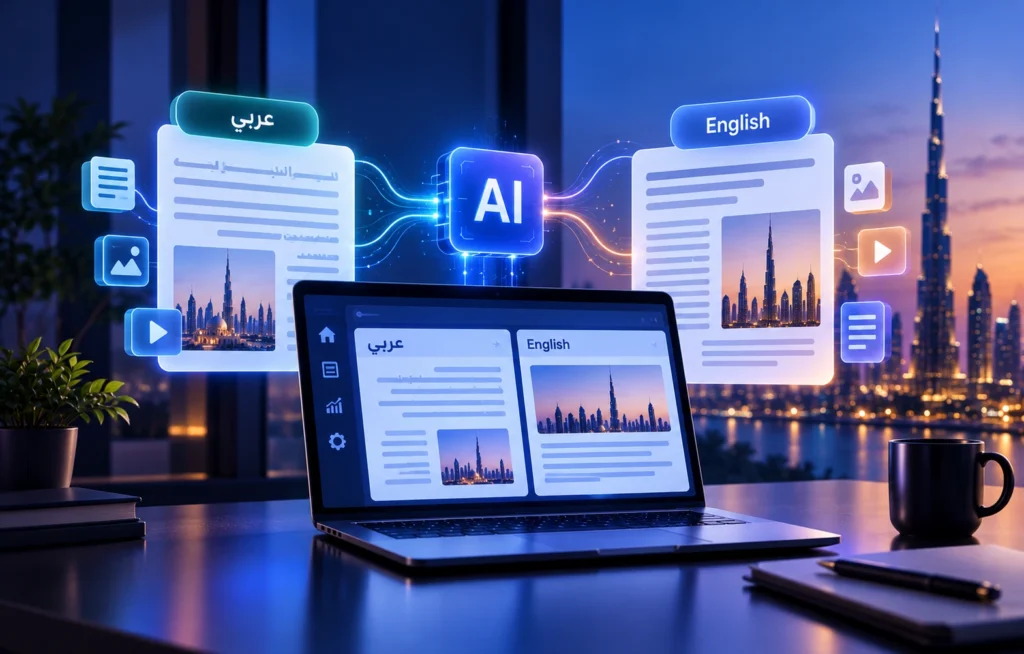
A retail brand in Dubai decided to get serious about content last year. The marketing team used an AI tool to produce a month of blog posts in English, then ran them through a translation step to create Arabic versions. The volume looked impressive on the content calendar. The results were disappointing. English pages picked up some traction. The Arabic pages sat almost unread, and when a customer service agent finally showed one to a native speaker, the verdict was blunt: it read like a manual translated by someone who had never been to a souk. The words were technically right. The tone, the phrasing, and the cultural assumptions were not.
That story is becoming common across the UAE. AI has made content cheap to produce, and that’s exactly why the cheap version is everywhere. Arabic and English audiences in the Emirates both expect quality, but they judge it differently, and most AI workflows are built for English first and then stretched to cover the rest. The businesses getting real results are doing something more deliberate: treating each language as its own audience, using AI for the heavy lifting, and keeping people accountable for the parts that determine whether content is trusted.
This article is a practical look at what works and what doesn’t when you run AI content marketing in both Arabic and English in the UAE, and how to build a workflow that doesn’t sacrifice one language for the other. If you’re building the wider picture, our earlier posts on AI digital marketing in the UAE, AI-powered ad campaigns in Dubai, and AI SEO in 2026 cover the surrounding channels in more detail.
Why Arabic Content Can’t Be an Afterthought
The UAE runs on two major languages, and for many businesses the Arabic audience is larger than they assume. Government communications, real estate, banking, healthcare, and a lot of consumer decisions happen in Arabic, even among people who work in English all day. Being present in both languages is not a nice extra. For a lot of categories, it’s where trust starts.
Search behavior reflects this. Arabic-language queries are growing, and many Dubai agencies still produce content almost exclusively in English, which leaves real room for businesses willing to invest properly in Arabic. That gap is also showing up in AI answers. Some of the commentary on UAE search points out that well-structured Arabic content is still relatively scarce compared with English content on the same topics, which makes good Arabic pages more likely to be picked up when an AI system needs a source. Treat that claim as directional rather than proven, but the logic holds: if the pool of good Arabic material is thin, quality Arabic content stands out.
The Arabic-English question also isn’t just about two separate sites or two separate blogs. Many UAE customers switch between languages within a single conversation or search session. A bilingual brand that feels consistent across both is easier to trust than one that seems to be two different companies.
What Doesn’t Work: Translating English Content
The most common mistake is also the most tempting one. You write strong English content, run it through a translation tool, and publish the result as Arabic.
Machine translation produces sentences that are grammatically plausible and often fine on a quick read. The problems show up in everything around the sentences. Arabic has its own rhythm, its own register for formal and informal communication, and its own expectations about how persuasion, respect, and warmth come across in writing. An English sales line that sounds confident can read as pushy or awkward in Arabic. A headline built on an English wordplay simply disappears. Idioms get translated literally and end up meaningless or unintentionally funny. Product descriptions lose the detail that makes them feel local.
There’s also an SEO cost. Search engines and AI systems are increasingly good at recognizing content that was clearly derived from another language rather than written for its audience. Translated pages tend to target the wrong phrases, because the way people search in Arabic isn’t always a direct equivalent of the English keyword. Someone looking for a service in English may use entirely different terms in Arabic, and a translated page won’t match them.
The fix is not to abandon translation entirely. It’s to stop treating it as the starting point. Write the Arabic version for an Arabic reader, using the questions and vocabulary that reader actually uses, and then decide whether an English version is needed or whether the English page should be written fresh for an English-speaking audience.
What Doesn’t Work: Publishing AI Arabic Without a Native Reviewer
AI tools can now produce Arabic that’s fluent enough to pass a casual glance. That’s exactly what makes unreviewed AI Arabic risky. The errors are harder to spot for non-native speakers in your team, and they can be more damaging than English errors, because a stiff or incorrect phrase reflects on how seriously you take the audience.
Some common problems show up repeatedly. Register can be wrong, with copy that’s too formal for a consumer brand or too casual for a government-adjacent or corporate context. Dialect can drift, mixing forms that sound odd to a native reader. Modern Standard Arabic is the usual choice for written marketing, but the balance between clarity and warmth depends on the audience. Terminology can be off for specialized fields. And cultural references can misfire entirely.
A native speaker should review every Arabic piece before it goes live, not just the headlines. That’s not a bureaucratic step. It’s the difference between content that feels trustworthy and content that quietly signals the brand doesn’t really understand the people it’s trying to reach.
What Works: Arabic-First Briefs
The most reliable approach we’ve seen in practice is to brief each language separately. The English brief defines the audience, the goal, the key message, and the question the reader is trying to answer. The Arabic brief starts from the same goal but includes a different understanding of the audience: what they’re worried about, what they search for, how formal the tone should be, and what proof they’re likely to trust.
This sounds like extra work, and it is. But it changes the output in a way that’s hard to get by editing a translated draft. An Arabic-first brief might lead to a completely different structure, a different example, or a different call to action. The English version might lead with price, while the Arabic version leads with reassurance or local credibility. Both can serve the same business goal while respecting how each audience makes decisions.
AI is genuinely useful inside this process. It can generate outlines, surface common questions, draft variants, and speed up research. The human editor’s job is to shape the result around the reader rather than around the source text.
What Works: Writing Original Questions and Answers
One of the strongest formats for both search and AI answers is a clear set of questions and direct answers. This works in both languages, but the questions need to be genuinely local.
For an English audience, the questions might be about cost, timelines, and how a service works in Dubai specifically. For an Arabic audience, the same service may generate different questions, such as concerns about documentation, language support, or trust in the provider. Research the questions people actually ask, through customer conversations, WhatsApp messages, sales calls, and Arabic search suggestions. Then answer them plainly, with specifics a reader can use.
This is where AI can help you scale without losing quality. A retrieval-based assistant that answers customer questions from your own approved Arabic and English content keeps answers consistent across channels and helps you spot the questions that keep recurring. Our AI-powered assistants are built on this kind of grounded answering, so the content you publish and the answers customers receive stay aligned.
What Works: Local Specifics Over Generic Claims
Generic content is the biggest problem in AI-produced marketing, in any language. “We provide high-quality solutions tailored to your needs” says nothing. In the UAE, specifics are what make content useful and believable: named neighborhoods, realistic timelines for local processes, pricing ranges where you can give them, examples of real situations clients in Dubai face, and references to the regulations or procedures that actually apply.
This also helps with AI visibility. When an AI system is deciding which source to cite, a page with concrete local detail gives it something to quote. A page full of vague marketing language gives it nothing. Specifics are harder to fake, which is also why they build trust with human readers.
What Works: Keeping the Brand Voice Consistent Across Languages
A brand can sound different in Arabic and English without sounding like two companies. The trick is to define the core values and the personality first, then express them in each language in a way that feels natural to that audience. Confidence might be expressed through direct statements in English and through measured, respectful phrasing in Arabic. Warmth might show up differently in each language, but the underlying character should be recognizable.
Write a short brand voice guide that covers both languages. Include examples of phrases you like and phrases you avoid, a few sample headlines in each language, and notes on tone for different content types, such as blog posts, social captions, and ad copy. Give it to every person and every AI tool involved in producing content. Consistency comes from shared standards, not from a single translator.
What Doesn’t Work: Mass-Producing Thin Content
It’s tempting to use AI to publish dozens of pages quickly, in both languages, covering every keyword you can think of. The result is usually a large library of thin, similar pages that add little value and dilute the site’s credibility.
Search systems and AI answer engines are getting better at ignoring this kind of content. A smaller number of pages that answer real questions well, in both languages, will almost always outperform a sprawling set of near-duplicates. Before publishing anything, ask whether it adds a specific answer, example, or perspective that isn’t already on your site. If the honest answer is no, don’t publish it.
What Works: Measuring Each Language Separately
If you blend Arabic and English performance into one number, you’ll miss what’s happening. An Arabic page can be quietly outperforming its English counterpart in engagement while looking weaker in total traffic simply because it’s newer or targets a smaller search volume. Track each language on its own: traffic, engagement time, inquiries, conversion, and how often each language’s content appears in AI answers.
Ask the same questions in both languages across AI tools and record which content is cited and how it’s described. You may find that your English content is reliably mentioned while your Arabic content is absent, or that the Arabic description of your business is outdated. Those are specific, fixable gaps.
Where Korvax AI Fits In
Building a bilingual content engine that’s fast, accurate, and trustworthy takes more than an AI writing tool. It takes a strategy for each language, a review process that protects quality, and measurement that shows what’s actually working.
Korvax AI is an AI automation agency based in Dubai, working with UAE businesses on exactly this. Our AI digital marketing services in Dubai cover AI-generated content with human editing as a standard step, alongside SEO, paid media, and analytics, so the content is built to serve the rest of the marketing system rather than sitting in isolation. For businesses that want their Arabic and English answers to stay consistent across the website, WhatsApp, and search, the grounded AI-powered assistants carry the same approved information into every conversation.
We start by understanding which languages and audiences actually drive your leads, then build a workflow with native review built in. That’s the approach that keeps content fast without making it sound like it came from a template.
The Bottom Line
AI content marketing in Arabic and English works when each language gets its own strategy, native review, local specifics, and honest measurement. It fails when the English version is simply pushed through a translator, when Arabic goes live without a native reader, or when volume replaces value.
The advantage goes to businesses that treat Arabic as a real audience rather than a translation target. Most of the market still hasn’t done that well, which means the opportunity is open for anyone willing to take the work seriously.
If you want to see where your current content stands in both languages, and which changes would make the biggest difference first, talk to Korvax AI and start from what your audience is actually reading.
