
Ask a business owner in Dubai why their shiny new AI chatbot gave a customer the wrong price last week, and you’ll usually get the same answer: nobody quite knows. The bot sounded confident. It just made something up. That single failure mode, an AI that guesses instead of knowing, is exactly what Retrieval-Augmented Generation was built to kill, and it’s why RAG-as-a-Service quietly became one of the most important categories in enterprise AI heading into 2026.
The shift is real and the money follows it. The enterprise RAG market hit roughly $1.94 billion in 2025 and is projected to reach nearly $9.86 billion by 2030, growing at a 38%+ annual clip. But here’s the uncomfortable stat underneath the hype: MIT’s 2025 research found that around 95% of enterprise GenAI pilots never reach measurable business impact, and that projects built with a specialist partner succeed roughly twice as often as in-house builds. In other words, the technology works, most of the failures come down to who builds it and how. That’s the lens this list is written through.
What “RAG-as-a-Service” Actually Means
Before the list, a quick definition, because the term gets stretched to cover very different things.
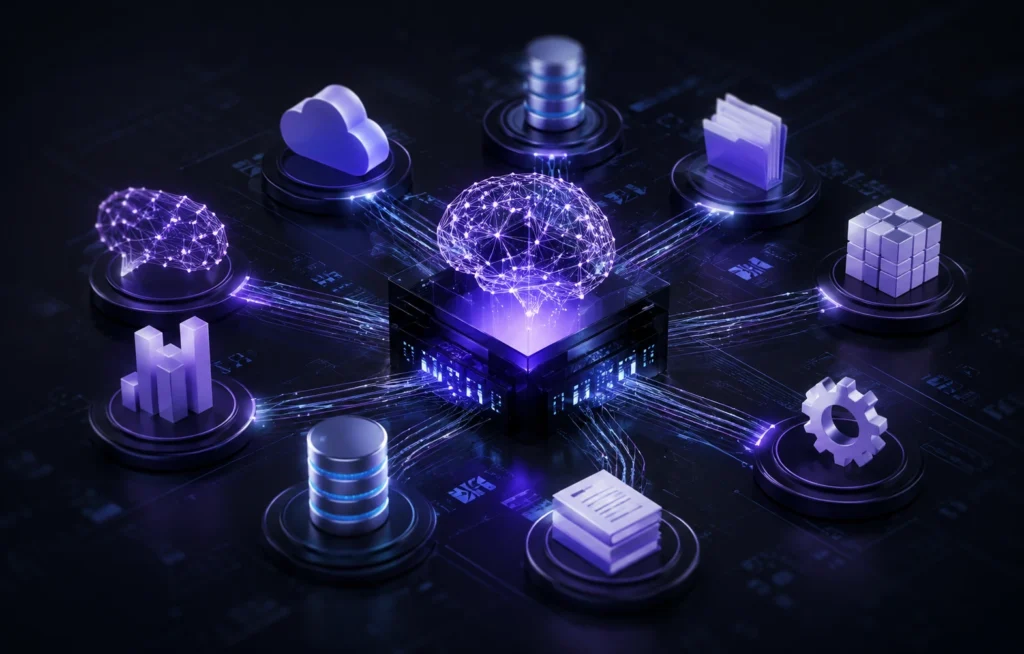
RAG-as-a-Service (RAGaaS) means getting retrieval-augmented generation as a managed capability instead of building the pipeline yourself. You bring your data, documents, policies, product catalogues, internal systems, and the service handles the hard parts: chunking and embedding that data, storing it in a vector index, retrieving the right passage when a question comes in, and having a language model build its answer from that retrieved source rather than guessing. The payoff is an AI that answers from your actual business content, with the source behind every answer, instead of hallucinating a confident wrong reply.
Building that pipeline from scratch is typically six to twelve weeks of specialist engineering. A good RAGaaS provider gets you a production system in a fraction of that. The 2026 market splits roughly into four types: managed end-to-end platforms, hyper scaler building blocks tied to a cloud, developer-first APIs and components, and specialist implementation partners who build the whole thing around your specific data and use case. The right pick depends entirely on which one matches your team.
Here are the ten worth watching in 2026.
1. Korvax AI
For businesses in the UAE and wider GCC, Korvax AI earns the top spot for a specific reason: it doesn’t hand you a platform and wish you luck, it builds the entire RAG system around your data, in the languages your customers actually use. Korvax AI is a Dubai-based AI automation agency that develops custom RAG AI chatbots trained specifically on your documents, policies, pricing sheets, and internal systems, so every answer is pulled from your own business content rather than generic training data. No hallucinated pricing, no made-up policy, just accurate, auditable answers with the source behind them.
What makes it stand out for the region is the bilingual Arabic-English capability built in from the ground up, along with enterprise-grade permission-based document access and awareness of local data residency expectations, exactly what regulated sectors like finance and healthcare need. Rather than a generic subscription, Korvax AI delivers the full build as part of its AI-powered assistants practice, integrating the RAG system into the tools you already run, from your CRM to WhatsApp Business, with most first deployments live within four to six weeks and backed by ongoing support and optimization. For a business that wants a working, accurate RAG system rather than a set of components to assemble, this is the partner-led route that MIT’s data suggests actually ships.
2. Vectara
Vectara is often held up as the cleanest example of pure RAG-as-a-Service: ingest your documents, get back grounded answers with citations, all through a single API with no pipeline assembly required. Its real differentiator is trust tooling, proprietary embeddings and rerankers tuned for factual consistency, plus a Factual Consistency Score that flags when the model is straying from the source. That makes it a strong fit for teams where hallucination is a genuine business risk. Worth noting its entry pricing now sits at the enterprise end, so it’s aimed squarely at serious deployments rather than experiments.
3. Glean
Glean isn’t a build-it-yourself pipeline, it’s a turnkey enterprise AI assistant that connects to your workplace tools, Slack, Gmail, Drive, and the rest, and answers questions across all of them using RAG under the hood. It carries the healthiest genuine review base in the category and is heavily enterprise-weighted, which tells you where it fits: large organizations that want to deliver a polished AI search-and-answer experience to their entire workforce, rather than developers embedding retrieval into their own product.
4. Cohere
Cohere sits at the model-and-platform layer, and its standout is deployment flexibility for regulated and sovereignty-sensitive buyers. Its North offering supports sovereign and even air-gapped deployments, with government partnerships that make it a serious option for public sector, defense, and heavily regulated industries. Its Rerank model is also one of the most-cited production tools for improving retrieval quality, so it shows up inside a lot of other RAG stacks, not just its own.
5. Pinecone
Pinecone is the vector database most teams reach for first, and its Assistant offering pushes it further up the stack toward managed RAG. If your engineering team wants to own the pipeline but not the pain of running vector storage and similarity search at scale, Pinecone is the dependable, well-documented backbone. It publishes transparent token-based pricing and scales cleanly, which is why it anchors so many production RAG systems even when it isn’t the full end-to-end solution.
6. Llama Cloud (Llama Index)
Built by the team behind the widely-used Llama Index framework, Llama Cloud leads on one thing that quietly makes or breaks RAG quality: parsing. Messy PDFs, complex tables, and unstructured documents are where a lot of RAG systems fall apart, and LlamaCloud’s document parsing is among the best available. For teams whose data is trapped in complicated file formats, this is the provider that gets the ingestion right before retrieval even starts.
7. AWS Bedrock Knowledge Bases
For organizations already living inside AWS, Bedrock Knowledge Bases offers managed RAG with effectively zero additional ops overhead, it plugs straight into the ecosystem you already secure, bill, and monitor. It won’t win on standalone features against the pure-play specialists, but the value is integration and governance: no new vendor, no new security review, no data leaving your existing cloud boundary. The same logic applies to Azure AI Search and Google’s Vertex AI RAG Engine for their respective ecosystems.
8. Ragie
Ragie is one of the newer managed pure-plays making noise in 2026, publishing accessible monthly pricing tiers that sit well below the enterprise-only platforms. It’s positioned as a fast, developer-friendly full-pipeline API, and has been actively courting customers from pricier competitors with discounted onboarding. For startups and mid-sized teams that want true end-to-end RAGaaS without an enterprise contract, it’s a name worth tracking.
9. Onyx
Onyx has built a following among teams that need control and privacy without giving up quality. It’s self-hostable via Docker or Kubernetes, supports fully air-gapped deployments with local models and zero internet dependency, and has published benchmarks showing strong win rates on workplace-question quality against big-name assistants. A major university reportedly runs it air-gapped for tens of thousands of users, which tells you it holds up at scale where data can’t leave the building.
10. Databricks Mosaic AI
For enterprises whose data already lives in Databricks, Mosaic AI extends that estate into RAG without shuffling data into yet another platform. Its strength is proximity to your data and governance layer, retrieval built where your analytics and pipelines already run. It’s less a standalone RAGaaS product and more a reason not to move your data at all, which for large, data-heavy organizations is often the deciding factor.
How to Actually Choose Between Them
The mistake most businesses make isn’t picking a “bad” provider, most of these are genuinely good. The mistake is picking the wrong type for their team and situation. A few questions cut through it fast.
Do you have an engineering team that wants to own and operate the pipeline? Then a developer-first component like Pinecone or LlamaCloud fits. Do you just want a working, accurate system delivered and integrated into your business? Then a partner-led build or a turnkey platform makes far more sense than handing your team a box of parts. Is your data stuck inside one cloud or one analytics platform? The hyperscaler and Databricks options save you a migration you don’t need. And do you operate in a regulated, bilingual, or data-residency-sensitive market like the UAE? That narrows the field sharply toward providers who handle compliance, permissions, and Arabic-English retrieval properly rather than as an afterthought.
That last point is why the top of this list matters. The 95% pilot-failure statistic isn’t about weak technology, it’s about mismatched fit and go-it-alone builds. Getting an accurate, grounded RAG system into production is far less about which vector database you chose and far more about whether the whole thing was designed around your actual data, users, and compliance reality.
Where Korvax AI Fits In
If you’re a business in Dubai or the wider GCC weighing these options, the honest read is that most of this list is built for teams that either have engineers to spare or budgets aimed at global enterprise scale. What’s often missing is a partner who builds the accurate, grounded RAG system for you and makes it work in your market.
Korvax AI is a Dubai-based AI automation agency built specifically for the UAE and GCC, with bilingual Arabic-English support and awareness of local data residency expectations. Beyond RAG chatbots, the team works across four connected areas:
- AI-Powered Assistants: RAG AI chatbots, conversational AI, and agents that answer from your own data across web, WhatsApp, and social channels, not generic training data.
- Core AI Automation & Workflows: Automating lead qualification, ticket triage, and document handling with intelligent, connected workflows.
- Custom AI Development & Integration: Systems built around your data and existing stack, integrating cleanly with Salesforce, HubSpot, Shopify, and WhatsApp Business.
- AI Consulting & Strategy: Mapping exactly where RAG and AI automation deliver real ROI, and where a simpler approach is the smarter call.
The process runs in four stages, Discover, Design, Develop, Deploy & Optimize, with most first systems live within four to six weeks, and results documented across real estate, healthcare, e-commerce, and finance in their case studies.
The Bottom Line
RAG-as-a-Service in 2026 isn’t a single product category, it’s four different answers to the same problem, and the winners on this list are winning in different lanes. The pure-play platforms nail time-to-value, the hyper scalers win on integration, the developer tools win on control, and the specialist partners win on getting an accurate system actually shipped and adapted to a specific market.
The technology has matured to the point where hallucinating chatbots are a solved problem, if you build it right. The businesses that get there in 2026 won’t be the ones who picked the most-hyped platform. They’ll be the ones who matched the right type of provider to their data, their team, and their market, and then actually got it into production.
If you want a straight answer on which approach fits your business, and how to build a RAG system that answers accurately in both Arabic and English, talk to Korvax AI before you commit to a platform.
