

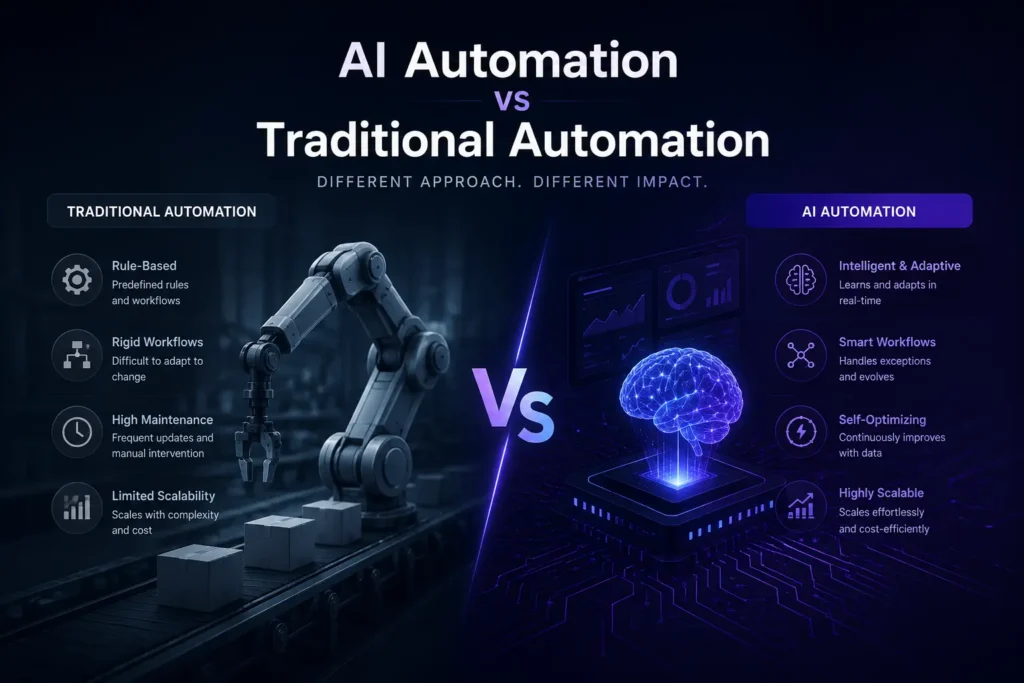
Ask five business owners in Dubai what “automation” means and you’ll get five different answers. Some are thinking of the rule-based software their finance team has used for a decade, the kind that moves an invoice from one folder to another if it matches a specific format. Others are thinking of the AI agents everyone’s suddenly talking about, the ones that read a customer message, understand what’s actually being asked, and respond like a person would. Both get called “automation.” They are not the same thing, and mixing them up is exactly how a lot of automation budgets get wasted.
The difference matters more in 2026 than it did even two years ago, because the cost of building real AI automation has dropped enough that it’s now a genuine option for mid-sized businesses, not just enterprises with in-house data science teams. That means the old default, “just automate it with a rule-based tool”, isn’t automatically the safe, cheap choice anymore. Sometimes it’s still the right call. Increasingly, it isn’t.
What Traditional Automation Actually Does
Traditional automation runs on rules someone wrote in advance. If X happens, do Y. If an order total is above a certain amount, flag it for approval. If an email contains a specific keyword, move it to a specific folder. It’s fast, predictable, and cheap to build for simple, repetitive tasks that never change shape.
The catch is right there in the definition: it only works for situations someone already anticipated. The moment a customer phrases a question slightly differently than expected, or a document arrives in a format the rules weren’t built for, traditional automation doesn’t adapt. It either fails silently or kicks the whole thing back to a human, which defeats the purpose of automating it in the first place.
This is why so many businesses have a drawer full of automation tools that technically work but quietly need constant babysitting. Someone’s always tweaking the rules, adding exceptions, patching around the edge cases the system can’t handle on its own.
What AI Automation Does Differently
AI automation doesn’t follow a fixed script, it interprets. Instead of matching an exact keyword, it understands the intent behind a customer’s message, even if it’s phrased in an unexpected way, written in Arabic and English in the same sentence, or missing information a rule-based system would need explicitly stated. Instead of flagging every document that doesn’t perfectly match a template, it can read the actual content, extract what matters, and make a judgment call within limits a business defines.
This is the real shift: AI automation can handle ambiguity, traditional automation can’t. A customer support conversation, a contract review, a lead qualification call, these all involve nuance that a fixed rule tree simply wasn’t built to capture. AI systems, especially ones built with retrieval-augmented generation pulling from a company’s actual data, can operate in that grey area without needing every possible scenario mapped out in advance.
A Side-by-Side Look
Handling repetitive, fixed-format tasks:
Traditional automation is often the more efficient and cost-effective choice here. Moving a file, triggering a notification, updating a status field, there’s no need for AI to interpret intent when the task is already completely defined. This is exactly where over-engineering happens, businesses sometimes reach for AI when a simple rule would do the job for a fraction of the cost.
Handling customer conversations:
AI automation wins clearly. Customers don’t phrase things consistently, they ask follow-up questions, they switch languages mid-conversation, they bring up context a rule-based flow was never designed to catch. A conversational AI system built for this can hold that context across a full conversation instead of resetting every time the input doesn’t match a script.
Handling documents and approvals:
This is where the gap is widest. Traditional automation can move a document based on its filename or a fixed field. It can’t read an invoice, flag a discrepancy against a purchase order, and route it correctly based on what it actually says. That requires data and document automation built around real content understanding, not folder rules.
Handling lead qualification and routing:
A rule-based system can route a lead based on a form field, say, budget above a certain number goes to a senior agent. AI automation can qualify a lead based on the actual conversation, tone, urgency, specific needs mentioned in passing, and route it with far more accuracy than a static form ever could.
Cost and maintenance over time:
Traditional automation is cheaper upfront but tends to accumulate patch after patch as new exceptions appear. AI automation costs more to build initially but requires far less manual patching, because it’s designed to handle variation rather than break on it.
Why This Distinction Matters for Dubai Businesses Right Now
The UAE market moves fast, and a lot of businesses jumped on “automation” broadly over the last few years without distinguishing between the two. That’s starting to show. Companies that automated with rigid, rule-based tools are hitting walls, their systems can’t keep up with bilingual customer expectations, can’t handle the volume of unstructured documents flowing through procurement and compliance, and need constant manual intervention to function.
Meanwhile, businesses that moved to genuine AI automation, agents that understand context, connect to real business data, and make bounded decisions, are seeing a very different outcome: fewer manual interventions, faster resolution times, and systems that actually improve as they’re used rather than degrading as edge cases pile up.
The businesses making the smartest calls in 2026 aren’t choosing one over the other categorically. They’re using traditional automation where it genuinely fits, simple, fixed, high-volume tasks, and reserving AI automation for everything that involves real ambiguity: conversations, documents, decisions, and judgment calls.
How to Decide Which One Your Business Actually Needs
A few questions cut through the confusion quickly:
- Does the task ever require interpreting intent, tone, or unstructured information?
If yes, traditional automation will eventually break. AI automation is built for exactly this.
- Is the task completely fixed and unlikely to change?
If yes, a simple rule-based tool is probably the faster, cheaper answer, no need to overbuild.
- How much manual patching is your current system needing every month?
If the answer is “constantly,” that’s usually a sign the task has more nuance than a rules engine can handle.
- Does the process touch customers directly, in more than one language?
That’s almost always a case for AI, not fixed rules.
Where Korvax AI Fits Into This
Getting this distinction right the first time saves months of rebuilding later, which is exactly where a specialized partner earns their keep.
Korvax AI is a Dubai-based AI automation agency that builds both ends of this spectrum correctly, simple rule-based automation where it genuinely fits, and real AI-driven systems where the work involves conversation, judgment, or unstructured data. Built specifically for the UAE and GCC market, with bilingual Arabic-English support and awareness of local data residency expectations, the team works across four connected areas:
- AI-Powered Assistants: Chatbots, RAG-based AI agents, and conversational AI that understand context and intent, not just keywords, across web, WhatsApp, and social channels.
- Core AI Automation & Workflows: Automating the processes that genuinely need judgment, lead qualification, ticket triage, document handling, without forcing a rigid rules engine onto tasks that don’t fit one.
- Custom AI Development & Integration: Systems built around your actual data and tech stack, integrating cleanly with platforms like Salesforce, HubSpot, Shopify, and WhatsApp Business.
- AI Consulting & Strategy: Helping businesses figure out exactly where AI automation makes sense and where a simpler, cheaper rule-based tool is genuinely the better call.
Their process runs in four stages, Discover, Design, Develop, Deploy & Optimize, with most first AI systems live within four to six weeks, backed by ongoing support and optimization once they’re running. Delivery spans real estate, healthcare, e-commerce, finance, and logistics clients across the UAE and wider GCC, with results documented in their case studies.
The Bottom Line
Traditional automation and AI automation aren’t competing versions of the same thing, they solve different problems. The mistake most businesses make isn’t picking the wrong one outright, it’s not knowing which situations call for which. Get that distinction right, and automation actually reduces work. Get it wrong, and you end up with a system that needs almost as much manual attention as the process it was supposed to replace.
If you’re not sure which side of that line your business’s biggest bottlenecks fall on, talk to Korvax AI and get a straight answer before you build anything.
