
At 11:47 PM on a Friday in Dubai, a real estate agent was looking at her phone one last time before bed.
200+ WhatsApp messages.
Most were property inquiries from clients who couldn’t wait until Monday. Some were serious. Some were tire-kickers. All of them needed responses, but she couldn’t respond to 200 messages in the morning and still close deals. So she ignored them, knowing she’d lose leads by Monday.
This happened every Friday night.
By the following Monday, 30-40% of those inquiries had moved on to her competitors who’d responded faster. She was essentially paying to lose leads every weekend.
This is when most people reach for a chatbot.
But here’s what she discovered: Not all chatbots are created equal. The cheap ones made things worse. The expensive enterprise ones were overkill. The right one a custom AI chatbot built specifically for her business, didn’t just handle the Friday night deluge. It actually improved her business in ways she wasn’t expecting.
The Reality of Customer Communication in 2026
In 2026, customer expectations have completely shifted. Here’s what we know:
- 73% of UAE business owners say their biggest operational challenge is response time (Source: UAE AI Adoption Survey, 2026)
- WhatsApp is now the primary communication channel for UAE customers, not email, not your website contact form
- Customers expect 24/7 availability, but hiring night-shift staff is expensive and hasn’t worked for most SMEs
- Bilingual support is no longer optional, especially in Dubai and KSA where Arabic and English speakers coexist
- Bot conversations that feel robotic are rejected immediately customers can tell when they’re talking to a script
The businesses thriving in 2026 aren’t trying to hire their way out of this problem anymore. They’re automating intelligently.
What Modern AI Chatbots Actually Do
If your last chatbot experience was a flowchart-based bot asking “Press 1 for Sales, Press 2 for Support,” you’re not alone. Those bots still exist, and they’re terrible.
Modern AI chatbots are fundamentally different. They:
1. Understand Context and Intent
Instead of matching keywords to scripts, modern chatbots understand what a customer actually needs. Ask one “Can I pay in installments?” and it understands you’re asking about payment options, not just searching for the word “installment.” It can refer back to previous conversation context, understand regional variations, and even pick up on tone.
2. Have Conversations, Not Transactions
Real conversations are messy. People ask follow-up questions, contradict themselves, go off-topic. Modern conversational AI handle all of that. They don’t freeze when you ask something slightly unexpected.
3. Integrate with Your Business Systems
A modern AI chatbot doesn’t exist in isolation. When a customer books an appointment, it creates a calendar entry. When they ask about an invoice, it pulls their order history. When they request a callback, it creates a task for your team with full context. It’s a bridge between your customer and your actual business systems. which made possible through deep AI integration.
4. Transfer Gracefully to Humans
The best chatbots know when they’re out of their depth and hand off to a human with full context already loaded. A customer doesn’t repeat themselves; the human immediately understands what’s been discussed. This is what agentic AI makes possible.
5. Learn and Improve Over Time
Traditional bots are static. Modern AI chatbots improve. They learn which responses customers find helpful, which escalations are actually necessary, and which questions are most common. Your chatbot gets smarter every month.
Seven Concrete Benefits for UAE Businesses
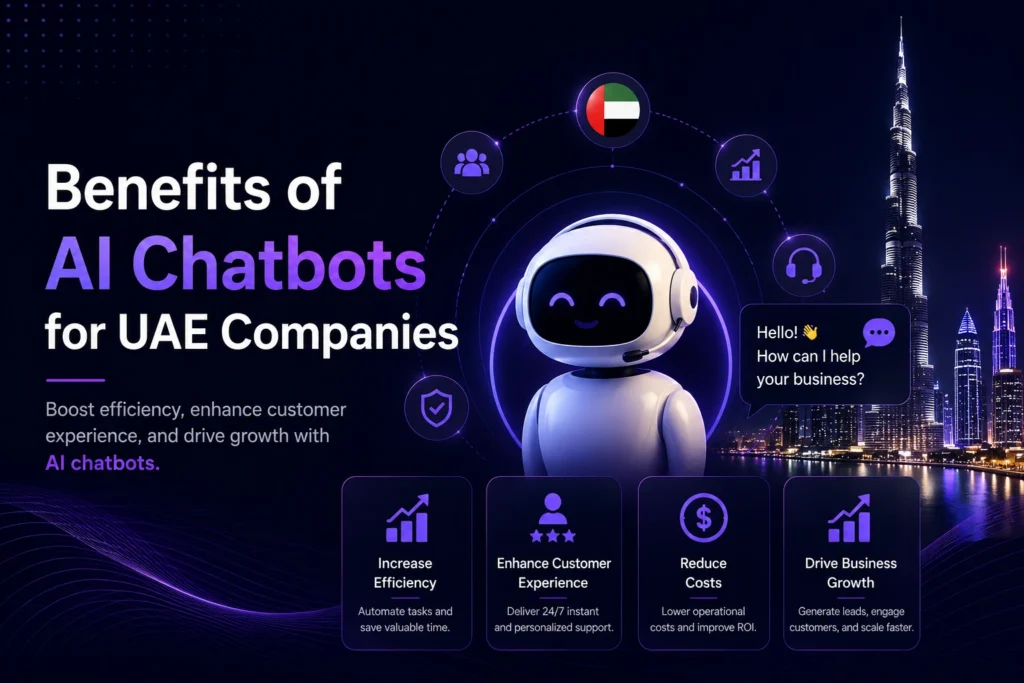
1. Unlimited Availability at a Fraction of Night-Shift Costs
Hiring a night-shift customer service rep costs ≈ 25,000 AED/month in salary + benefits. Your chatbot costs a fraction of that and never sleeps.
Real Example: A healthcare clinic in Riyadh saw patient inquiries after hours jump 300% when they added a chatbot. Instead of losing those inquiries, they captured 95% and scheduled them as appointments. The clinic stayed open 24/7 without hiring anyone.
2. Instant Response Times = Better Conversions
When a customer gets a response in 30 seconds instead of 4 hours, they’re 3x more likely to move forward.
Real Example: The real estate agency I mentioned earlier got 38% improvement in lead-to-viewing conversions after adding a bilingual WhatsApp chatbot. Faster response → faster qualification → faster pipeline.
3. Bilingual Support (Arabic + English) Without Hiring Bilingual Staff
The chatbot serves both languages natively. Arabic speakers talk to it in Arabic. English speakers in English. No translation delays. No cultural misunderstandings.
Real Example: A B2B services company in Dubai went from losing 15% of Arabic-language inquiries (due to slow response time) to capturing 94% after adding native Arabic chatbot support.
4. Consistent Quality Every Single Interaction
Human customer service reps have bad days. They get tired. They make mistakes. Generative AI-powered Chatbots don’t. Every customer gets the same high-quality response at 2 AM on a Friday as they do at 2 PM on a Monday.
Real Example: A fintech startup in KSA moved all KYC questions to their chatbot and saw approval times drop from 2-4 hours (when routed to humans) to 10 minutes, with zero compliance issues.
5. Freed-up Staff Hours for High-Value Work
When your customer service team isn’t drowning in routine questions, they can finally focus on complex issues, relationship building, and sales. This is the promise of AI automation and workflows, and your team gets happier because they’re not stuck in repetitive work.
Real Example: An e-commerce team in Dubai went from handling 400+ daily customer messages to handling 60, with the same team size. The other 340+ were handled by the chatbot. The result? Their team actually had time to work with VIP customers and handle returns properly instead of ignoring them.
6. Data Insights About Your Customers
Every conversation is a data point. Your chatbot is collecting intelligence about:
- What customers actually ask about (not what you think they ask about)
- When peak inquiry times are
- What questions lead to conversions (and which don’t)
- Which products generate the most questions
- Customer sentiment and satisfaction signals
This kind of intelligence is surfaced through data and document automation built directly into the system.
Real Example: A luxury real estate firm realized their chatbot logs showed that 40% of inquiries were about payment plans something they weren’t even promoting. They added a finance partner, updated their marketing, and saw application volume jump 50%.
7. Reduced Support Ticket Volume (And Costs)
Fewer human-routed inquiries = fewer support hours = lower overhead. Pair this with AI agents and advanced automation and your support function runs itself.
Real Example: A healthcare group running three clinic branches saw support ticket volume drop 55% after deploying a chatbot. Same service quality, way lower headcount requirement.
Real Examples: How Different Industries Use Chatbots
Real Estate (Dubai & KSA)
The real estate AI chatbot qualifies every lead the moment it arrives:
- Is this a serious buyer or just browsing?
- What’s their budget range?
- What location are they interested in?
- When do they want to see properties?
By the time a sales agent talks to them, the lead is already pre-qualified. The agent closes instead of qualifies. The result? Conversion rates jump 25-40%.
One real estate firm’s WhatsApp chatbot now books 80% of viewing appointments without human involvement.
Healthcare (Dubai, Riyadh)
The healthcare AI chatbot handles pre-visit logistics:
- Appointment booking and rescheduling
- Pre-appointment questionnaires (medical history, symptoms)
- Insurance verification questions
- Billing and pricing questions
- Pre- and post-appointment reminders
One multi-clinic health network reduced no-show rates by 27% and cut admin time by 50%. Doctors spend more time with patients instead of handling scheduling.
E-Commerce (Dubai, KSA, USA)
The e-commerce AI chatbot is a sales agent that works 24/7:
- Product recommendations based on browsing history
- Abandoned cart recovery with personalized incentives
- Order status tracking (cuts down on “where’s my order?” emails)
- Returns and refunds processing
- Size/compatibility questions answered instantly
An online store in Dubai+KSA saw cart abandonment drop 22% and average order value increase 18% after adding chatbot recommendations.
Finance & B2B Services (Dubai, KSA)
The finance AI chatbot qualifies prospects before they ever talk to a sales rep:
- Identify decision-makers vs. information-seekers
- Understand budget and timeline
- Disqualify misaligned prospects early
- Nurture prospects automatically while sales team focuses on hot leads
A B2B solutions company in Austin saw their close rate jump 31% because their sales team spent zero time on unqualified leads.
The Economics: ROI Timeline
Let’s be honest. ChatGPT is free. So what makes a custom AI development investment worth it?
Because a custom AI chatbot does more than chat, it connects to your systems, understands your business, and drives measurable revenue.
Typical ROI Timeline:
Month 1: You absorb setup costs. But you immediately start seeing:
- Reduced response time (customers notice)
- Freed-up hours (staff notices)
Month 2-3: The financial benefits compound:
- Conversions improve (faster response = better close rate)
- Support costs drop (fewer tickets)
- Hours saved = real productivity (your team does more)
By Month 3-4: You’ve typically recovered your investment and are running pure profit.
Real Numbers:
- A clinic saved $4,000/month in admin hours + gained $2,000/month in prevented no-show losses = $6,000 monthly benefit
- A real estate firm gained $1.2M in additional pipeline value + saved $1,500/month in response time = massive ROI
- An e-commerce store added $50,000+/month during peak season through cart recovery + upselling
Setup costs typically range from $3,000–$15,000 depending on complexity and integrations. Most businesses hit ROI within 90 days.
What to Look for in an AI Chatbot Partner
Not all chatbot vendors are equal. Here’s what actually matters:
1. Native Language Support (Arabic Must Be Real)
If they say “we support Arabic,” ask if they trained the model on Arabic or if they’re translating English responses. Big difference.
Real Arabic support means:
- Understanding Arabic dialects and regional variations
- Native fluency, not translated English
- Respect for cultural context (how you ask matters in Arabic)
2. Platform Integration Out of the Box
Can they integrate with WhatsApp Business, your CRM, your e-commerce store? Do they have pre-built integrations or do they say “custom API development”? Pre-built is faster.
3. Industry Examples
They should have case studies from your specific sector. A healthcare-focused partner is more valuable than a generic chatbot vendor.
4. Transparency About Limitations
The best vendors will be honest: “Our chatbot handles 90% of common questions, but these types of requests need human review.” Not all vendors will admit that. This is part of Korvax’s AI consulting approach honest strategy before a single line of code is written.
5. Clear Onboarding and Training
Your team needs to understand how it works, how to monitor it, and how to improve it. Training should be included, not an upsell.
6. Post-Launch Optimization
Deployment isn’t the end. Your vendor should monitor performance, suggest improvements, and continuously refine responses based on real conversations.
The Competitive Reality
In 2026, AI chatbots are no longer a competitive advantage. They’re becoming table stakes. The businesses that adopted chatbots in 2024 are now competing at a new level because their response times are faster, their teams are more productive, and their conversions are higher. Businesses without chatbots are scrambling to catch up.
If your competitors already have chatbots and you don’t, you’re losing leads every single day, especially on nights and weekends when you’re asleep but your customer is shopping. Whether you’re just getting started or looking to scale with AI, Korvax AI is here to help. Share your requirements, and let’s build the right solution together.
