

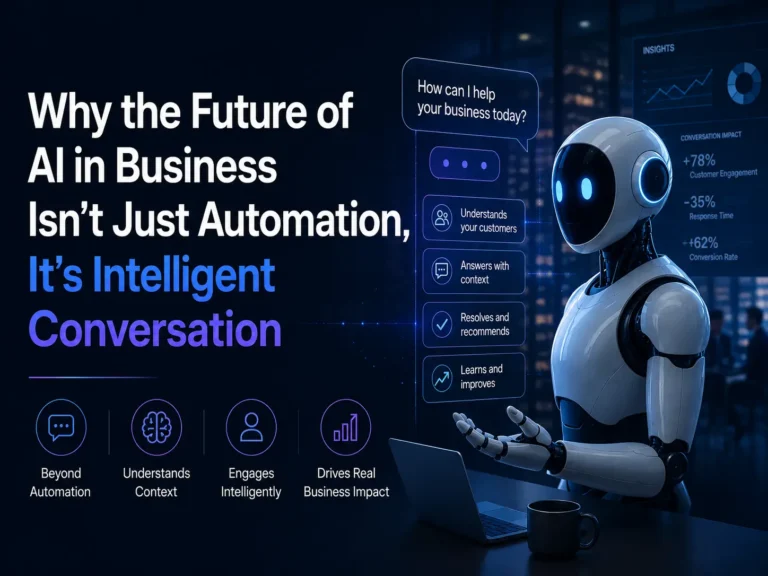
Enterprises that treat AI as a back-office efficiency tool are missing the bigger opportunity. The companies winning right now are the ones building AI that talks, listens, and closes.
For the better part of a decade, the enterprise conversation around artificial intelligence has revolved around a single word: automation. Automate the invoice. Automate the report. Automate the workflow. And while back-office efficiency gains are real and measurable, a significant shift is underway, one that reframes where AI creates the most durable competitive advantage.
It is not in the spreadsheet. It is in the conversation.
The businesses pulling ahead in 2026 are not the ones with the most automated pipelines. They are the ones whose AI can hold a meaningful exchange, understanding intent, remembering context, resolving complex queries, and driving action, across every channel their customers already use. The distinction between automating a task and intelligently conversing with a human is proving to be the single largest differentiator in customer experience, sales, and operational performance this year.
From scripted responses to intelligent agents
The first wave of enterprise chatbots earned a poor reputation for good reason. Rule-based, brittle, and frustratingly scripted, they functioned more as interactive FAQ pages than genuine conversational partners. By 2026, that era is definitively over.
According to Gartner’s enterprise adoption research, 78% of organizations have migrated from rule-based chatbot systems to large-language-model-powered generative AI in just 18 months, one of the fastest technology transitions on record. What changed is not merely the sophistication of the models; it is what they are now able to do in context. Today’s conversational AI systems understand multi-turn dialogue, retain memory of prior exchanges, adapt tone and language to the customer’s profile, and critically take action within connected enterprise systems rather than simply returning a text response.
“The future of chatbots and conversational AI in enterprise settings will be defined by domain-aligned assistants, rigorous evaluation frameworks, and governance engineered into runtime behavior.” Tech Blocks Conversational AI Report, 2026
This is a fundamental architectural shift. The conversational layer is no longer an add-on sitting in front of a human support team. It is becoming the primary interface between a business and its customers, suppliers, and internal workforce, an execution layer that can verify eligibility, initiate transactions, update records, and trigger downstream workflows without requiring manual intervention.
The numbers behind the shift
The commercial case is no longer speculative. The conversational AI market has grown from $4.8 billion in 2023 to $16.1 billion in 2026, a 175% increase that reflects deepening implementation across industries, not simply inflated expectations. Enterprise adoption has reached 78%, with companies reporting average efficiency improvements of 67% in customer service operations and 45% increases in sales-qualified leads generated through AI-driven interactions.
For organizations managing high customer interaction volume, the economics are particularly sharp. Gartner projects conversational AI will eliminate $80 billion in global contact-center labor costs by the close of 2026. Enterprises that have deployed AI agents at scale in their support functions report per-interaction cost reductions of up to 92%, with most organizations achieving payback within three to six months. The AI agents using copilot assistance close 31% more conversations per day than their unassisted counterparts.
Industry adoption leaders in 2026
- Retail and e-commerce: 21.2% global market share, driven by order management and hyper-personalized engagement
- Healthcare: AI-assisted triage and scheduling projected to save the sector $150 billion annually
- Financial services: Compliance validation, reporting automation, and multilingual customer support
- Real estate: End-to-end lead qualification, property matching, and viewing coordination via AI agents
- Logistics: AI dispatchers processing orders, assigning resources, and sending confirmations in real time
Want to see how AI agents are driving results in your industry? Take a look at our Industries page for real-world use cases and solutions.
Why the GCC is at the center of this conversation
Nowhere is the transition from AI Automation to intelligent conversation more commercially urgent than in the Gulf Cooperation Council region. The UAE and Saudi Arabia have among the highest WhatsApp penetration rates on the planet, 96% of UAE smartphone users and 94% of Saudi smartphone users actively use the platform, making it the primary customer service channel for the region’s businesses by a substantial margin.
WhatsApp AI chatbots now hold a 38% share of the GCC’s conversational AI market, the highest regional penetration globally. The local AI market as a whole is projected to grow from $2.14 billion in 2025 to $16.9 billion by 2032, at a compound annual growth rate of 34.3%. Organizations that have deployed Arabic-language AI across their WhatsApp channels are reporting support cost reductions of up to 60% and measurable increases in lead conversion, not through aggressive automation, but through the quality of the conversation itself.
The availability of high-quality Arabic-language AI for the first time in 2024 and 2025, including Gulf dialect recognition and near-native understanding from GPT-4o and Gemini Arabic, has been identified as the single most important market driver in the GCC AI chatbot segment over that period. Businesses that previously faced a language barrier to AI adoption are now deploying bilingual agents that serve Khaleeji and Levantine Arabic speakers with the same fluency as English-language customers.
The strategic mistake most businesses are still making
Despite the clarity of the commercial evidence, a significant portion of enterprise AI investment continues to be structured around back-office process automation rather than customer-facing conversational intelligence. This reflects a broader pattern that has defined the AI adoption failure mode of 2025 and 2026: the technology is often implemented where it is easiest to implement, rather than where it creates the most value.
The data on this is unambiguous. IBM found only 25% of enterprise AI initiatives delivered expected ROI. Morgan Stanley identified that just 21% of S&P 500 companies could cite a measurable AI benefit at all. MIT’s GenAI Divide research puts the failure rate of enterprise generative AI projects, defined as not delivering measurable financial returns within six month at a staggering 95%.
The cause is rarely the model. It is structural: fragmented data, governance gaps, and a tendency to pilot AI in isolated environments rather than connecting it to the customer journeys and business workflows where it can actually move the needle. A chatbot deployed as a cost-reduction exercise, divorced from revenue context, will deliver limited returns. The same technology, deployed as a full-spectrum conversational agent embedded across sales, support, and operations, changes the economics of an entire customer relationship.
“The future belongs to organizations that view conversational AI not as automation technology, but as relationship infrastructure that creates value for customers and sustainable growth for businesses.” Oscar Chat Conversational AI Trends Report, 2026
What intelligent conversation actually looks like in practice
The distinction between task automation and intelligent conversation becomes concrete when you examine what the best implementations are actually doing. A real estate firm in Dubai is not simply using AI to answer property FAQs, it is deploying an AI agent that qualifies buyer intent, matches listings to stated and inferred preferences, books viewings, and follows up post-showing, all within the WhatsApp thread the buyer opened. A healthcare provider is not routing appointment requests, it is triaging patient symptoms, coordinating with clinical records systems, confirming bookings, and sending preparation instructions in the patient’s preferred language. A logistics operator is not sending tracking updates, it is handling multi-step dispatch coordination, exceptions management, and driver communication through a single conversational interface.
In each case, the conversation is not a front-end to a manual process. It is the process. The AI holds context across the entire interaction, connects to backend systems in real time, and produces outcomes, not responses.
This is the architecture Korvax AI builds for ambitious businesses across the UAE and GCC. Our conversational AI systems are fine-tuned on client-specific knowledge bases, deployed across WhatsApp, Telegram, Instagram, and web, and connected to CRM, ERP, and operational systems. They are not chatbots in the traditional sense. They are intelligent agents that represent a business in every conversation, at every hour, across every channel, and they are designed from the ground up to deliver measurable commercial outcomes, not just deflection rates.
The window is narrowing
Forrester projects that enterprises will begin deferring 25% of planned AI spend into 2027 as financial pressure forces a reckoning between vendor promises and actual delivered value. The organizations that will be best positioned when that correction arrives are those who have already moved from pilot to production, who have connected their AI investment to revenue lines their leadership can see and trust.
The business case for intelligent conversation is no longer theoretical. It is documented in billions of dollars of market growth, in the operational benchmarks of enterprises that have made the transition, and in the commercial performance of the GCC businesses that have turned WhatsApp into a genuine revenue channel. The question is not whether conversational AI will redefine how businesses build customer relationships. That is already happening. The question is whether your organization is building the right conversation.
